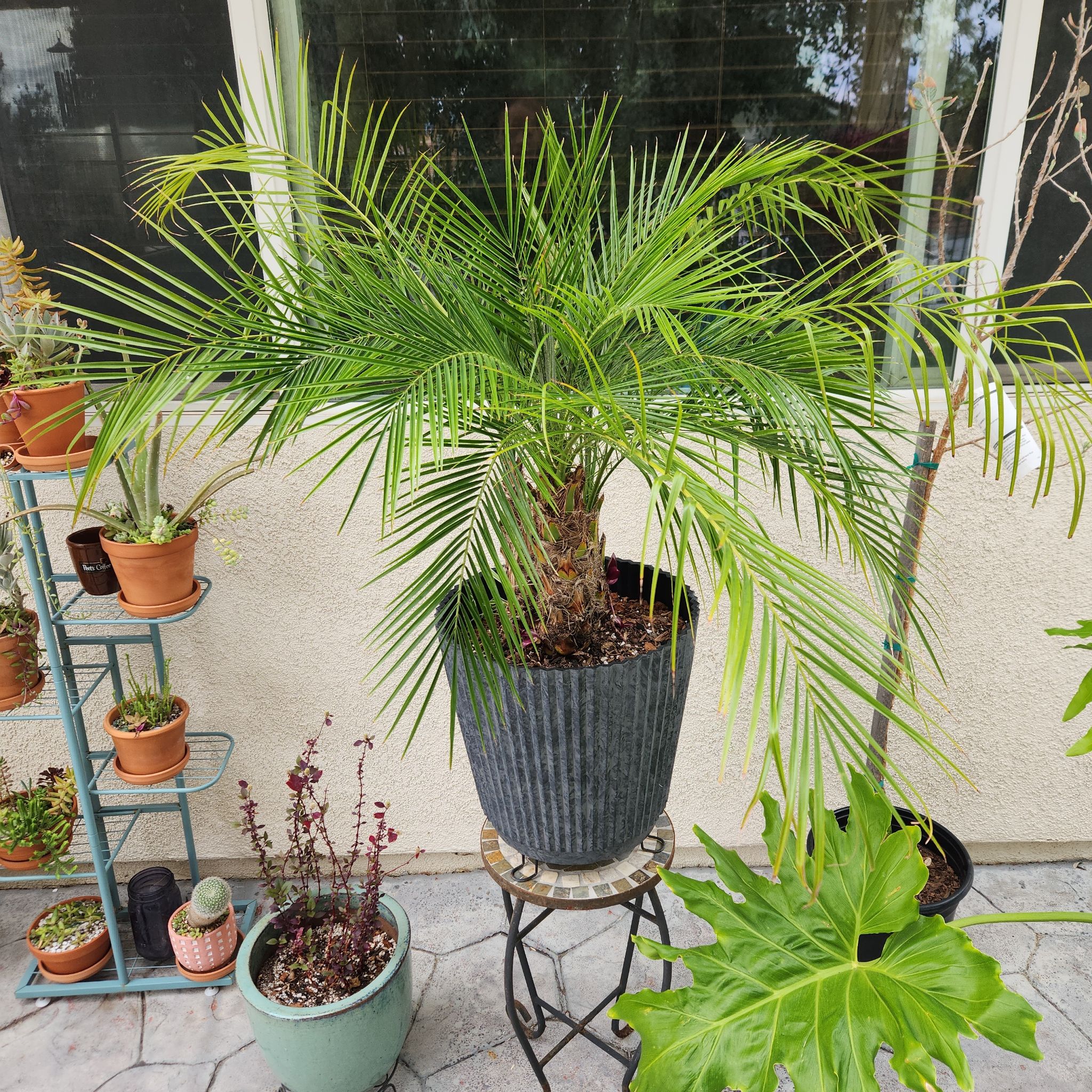
What's Wrong with My Pygmy Date Palm?

Common Pygmy Date Palm Problems
Brown leaf tips
Pygmy Date Palm is one of the more fluoride-sensitive palms sold as a houseplant. Mineral salts accumulate in the frond tips with every watering, killing the tissue in a sharp, distinct line rather than a gradual fade. The damage keeps advancing as long as tap water is used, regardless of humidity or watering frequency.
Native to river banks in Laos and Vietnam, Pygmy Date Palm is used to moderate-to-high humidity. Its fine feathery leaflets lose moisture fastest at the tips, which are furthest from the root supply. Browning from dry air is softer and more gradual than the sharp line left by fluoride buildup.
Pygmy Date Palm prefers evenly moist soil. When the root ball dries out completely, moisture is pulled back from the frond tips first. The browning looks similar to humidity damage and the two often occur together in the same dry indoor environment.
Yellow patches on old fronds
Pygmy Date Palm, like other Phoenix palms, is prone to potassium deficiency in containers. Potassium moves out of the oldest fronds first, causing yellow-orange spots or patches on the lower, older leaves while new growth at the top stays green. Container soil loses potassium quickly, and it is not replaced by a standard general fertilizer.
Pygmy Date Palm continuously pushes new growth from its central crown and sheds the oldest lower fronds as it matures. One or two lower fronds yellowing while the rest of the palm looks full and healthy is normal energy reallocation. No action is needed beyond trimming the spent frond.
Dying fronds
Whole fronds browning and dying from the base usually signals root rot. Pygmy Date Palm evolved in well-drained river bank soils and its roots cannot survive extended waterlogging. Once multiple fronds start dying together, the roots below are usually badly damaged and the base of the trunk may feel soft.
Pygmy Date Palm does not tolerate repeated dry-downs the way a desert palm does. Extended dry spells cause older fronds to die back as the plant pulls moisture from them to protect new central growth. If the central crown spear is still firm and green, the plant can recover with corrected watering.
Spider mites
Spider mites are the most common indoor pest of Pygmy Date Palm. Dry air is their main invite, and the palm's dense feathery fronds give mites a vast surface area to colonize before the infestation becomes obvious. Fine webbing appears between leaflets and on frond undersides first, while the upper surface develops pale stippled speckles.
Sparse, slow growth
Pygmy Date Palm naturally grows in bright, open riparian areas and needs more light than its compact size suggests. In genuinely low light, fronds emerge fewer and farther apart with pale yellow-green coloring instead of the deep green it shows in good light. Growth slows to nearly a standstill in dim interiors.
Preventing Pygmy Date Palm Problems
About This Article
