What's Wrong with My Calathea Orbifolia?

Common Calathea Orbifolia Problems
Brown crispy edges
Calathea Orbifolia is one of the most fluoride-sensitive houseplants you can own. Minerals in tap water accumulate at the outer edges of its enormous round leaves, where moisture evaporates, and kill the cells there. The damage shows as a uniform crispy brown border tracing the whole circumference of the leaf.
This species evolved on the humid floor of Bolivian rainforests and needs 60%+ humidity to stay comfortable. In dry indoor air, the outer edges of the large round leaves lose moisture faster than the roots can supply it and brown off first. The bigger the leaf, the more obvious the damage.
Curling leaves
When the soil dries out, Calathea Orbifolia rolls its large round leaves inward lengthwise to cut down on surface-area water loss. The curl is fast and obvious because the leaves are so wide. All leaves tend to curl at once since the entire plant draws from the same root system.
Dry air triggers the same rolling response as dry soil, and the two problems often stack. Calathea Orbifolia's leaves are large enough that they lose significant moisture through their surface in dry conditions. If the soil is moist but leaves are still curling, the air is the culprit.
Yellow leaves
Calathea Orbifolia grows from a shallow rhizome that sits close to the soil surface and rots quickly in waterlogged conditions. When the rhizome breaks down, nutrients stop moving up through the plant and the oldest outer leaves yellow first, working inward.
Calathea Orbifolia occasionally retires its oldest outer leaves as fresh growth pushes from the center. A single yellowing leaf at the outside edge of the clump while the rest of the plant looks healthy is normal energy reallocation, not a problem.
Fading silver pattern
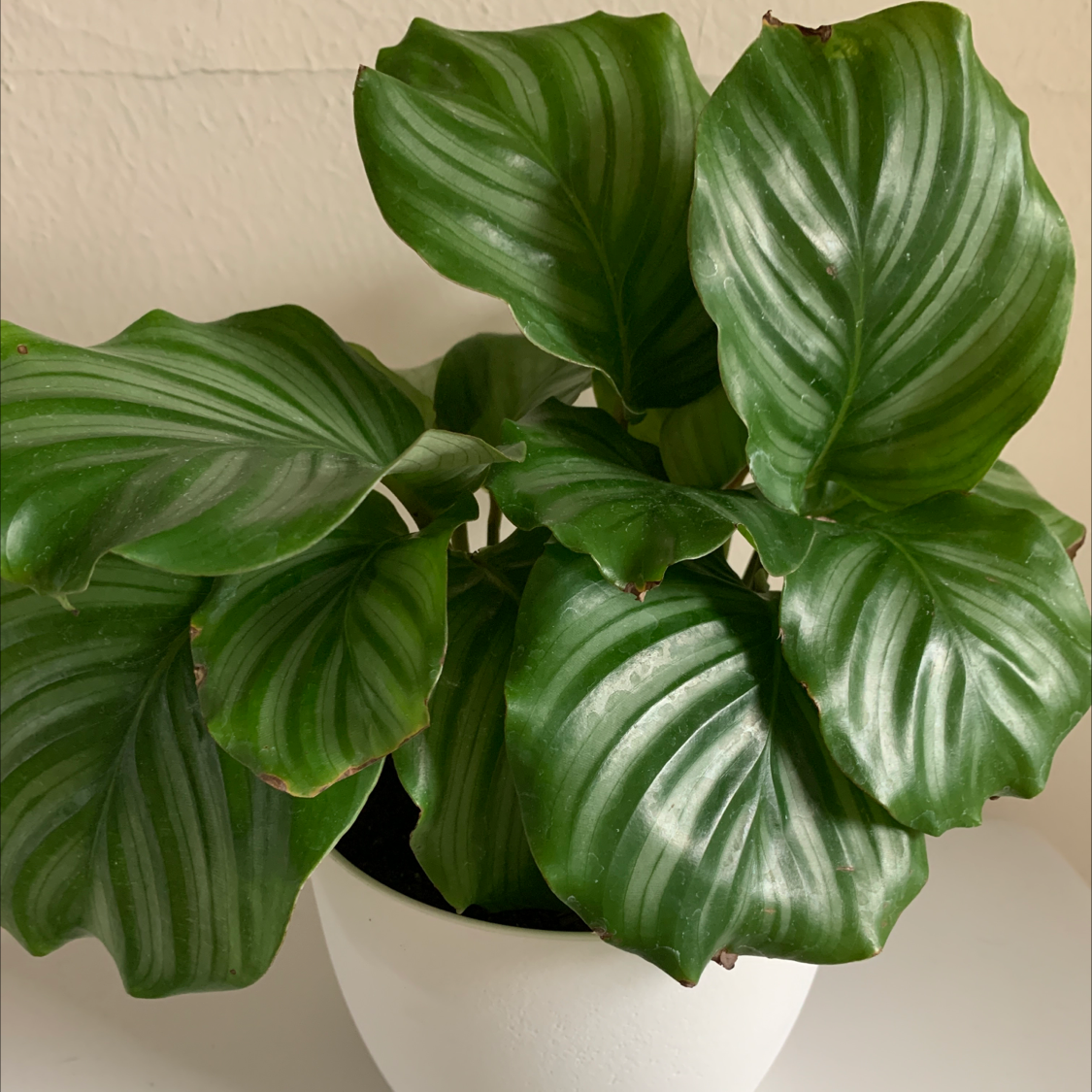
The broad silvery-green ovals and dark radiating stripes are Calathea Orbifolia's defining feature. The plant invests in that pigment only when light is adequate. In dim conditions, new leaves emerge with washed-out, faint markings because the plant has no reason to produce pigment it cannot use for photosynthesis.
Too much direct light bleaches the silvery areas and leaves pale or white patches in the center of the big round leaves. The large flat surface catches intense rays easily, and because the leaves are held horizontally to catch filtered light, even a few hours of direct afternoon sun causes visible bleaching within days.
Leaves not folding at night
Calathea Orbifolia folds its leaves upright at night using small motor cells at the base of each leaf stem that swell and contract with water pressure. When the plant is stressed by dry air, dry soil, fluoride damage, or root trouble, those cells lose the water pressure they need to move. The folding stops before other symptoms become obvious, making it one of the earliest stress signals this species shows.
Pests
Spider mites love low humidity, and Calathea Orbifolia rarely gets enough of it in most homes. The large flat leaves provide an enormous feeding surface, and fine webbing appears on the undersides and along the leaf edges before most owners notice. Pale stippling across the upper surface is usually what catches the eye first.
Tiny black flies hovering around the soil signal fungus gnats. Their larvae live in the top inch of moist potting mix. Because Calathea Orbifolia needs consistently moist soil and high humidity, the conditions that keep it alive are also ideal for gnat breeding.
Preventing Calathea Orbifolia Problems
About This Article
