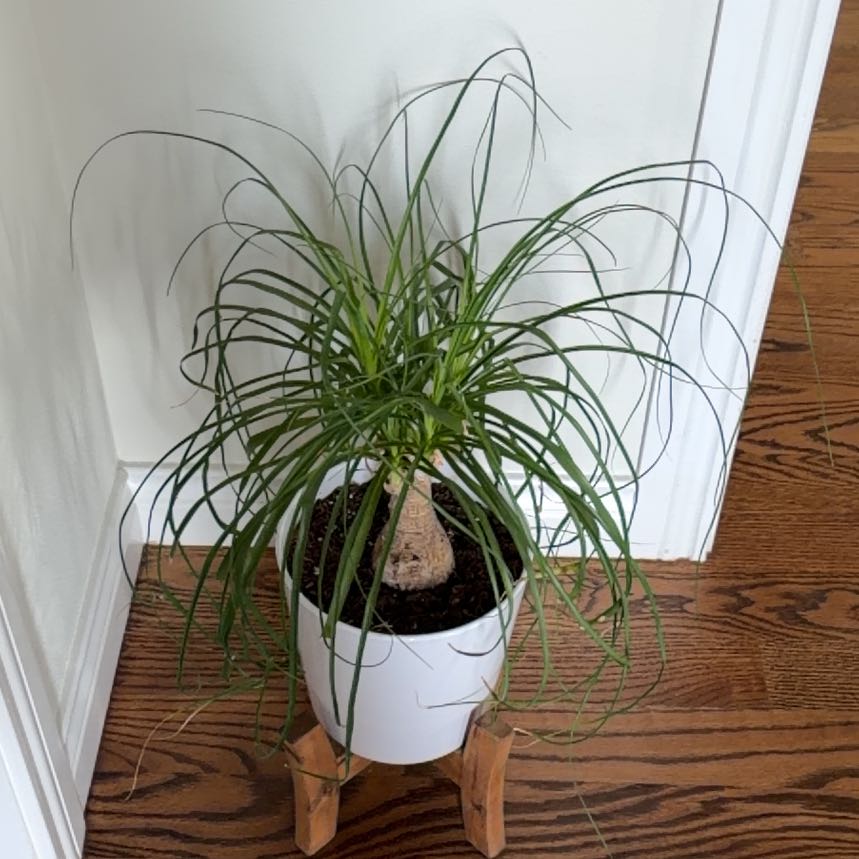
What's Wrong with My Ponytail Palm?

Common Ponytail Palm Problems
Mushy base
The swollen base of a Ponytail Palm is a water storage organ. When the soil stays wet too long, the roots sitting in that moisture rot, and the decay spreads up into the base itself. The base goes from firm to soft, often turning brown or black. This is the most common way this plant dies indoors.
Yellow leaves
When the roots rot from soggy soil, the plant can no longer pull nutrients up to the leaves. The long ribbon-like leaves yellow from the base of the leaf upward, and the effect spreads across multiple leaves at once. A soft or discolored base alongside the yellowing confirms overwatering.
Ponytail Palm is native to semi-arid Mexico and needs strong light to stay green and grow. In low light, the whole head of leaves gradually pales to a washed-out yellow-green. Unlike overwatering yellowing, this happens evenly across all the leaves rather than starting at the base.
Brown tips
Ponytail Palm's long thin leaves are sensitive to fluoride and salts in tap water. As water moves through the leaf to the tip, minerals accumulate there and the tissue dies, leaving a dry brown edge. This is the most common reason for tip browning and is cosmetic rather than dangerous.
Ponytail Palm grows very slowly and needs almost no fertilizer. Feeding it on a regular schedule built for faster-growing houseplants builds up salts in the soil that burn the leaf tips. The tips brown and crisp identically to tap water damage, but the pattern worsens with each feeding.
Soft base
The swollen base shrinks and wrinkles when the water stored inside has been drawn down over many months without a refill. This is unusual because the plant tolerates drought so well, but if ignored long enough the base will lose its rounded shape and feel slightly soft or leathery. This is different from rot because the base will firm back up after a good watering.
Dry, breaking leaves
The lowest and oldest leaves on a Ponytail Palm dry out, turn brown, and eventually break off as the plant ages. This is a normal part of the growth cycle. The plant pushes new growth from the top growing point and lets the oldest leaves go. If only the lowest ring of leaves is affected and the rest of the plant looks healthy, no action is needed.
If the plant has gone without water long enough to exhaust the reserves in its base, leaves across the whole head can dry out and become brittle rather than just the lowest ring. The texture is crispy throughout rather than just at the tips, and leaves snap rather than bend.
Pests
Fine webbing between the ribbon-like leaves and stippled or faded patches on individual leaves are the signs. Dry indoor air is the main driver. The long, tightly packed leaves on a Ponytail Palm create shelter for mites to multiply before the damage is obvious.
White cottony clusters appear at the base of the leaf cluster, where the individual leaves emerge from the growing tip, and sometimes on the upper surface of the swollen base. The leaf cluster on a mature Ponytail Palm is dense enough that mealybugs can build up in the interior before they are visible from outside.
Small tan or brown waxy bumps on the swollen base or along the lower trunk. Scale insects attach to the surface and suck sap from the tissue below, leaving small yellowed spots on the base around each feeding site.
Preventing Ponytail Palm Problems
About This Article
