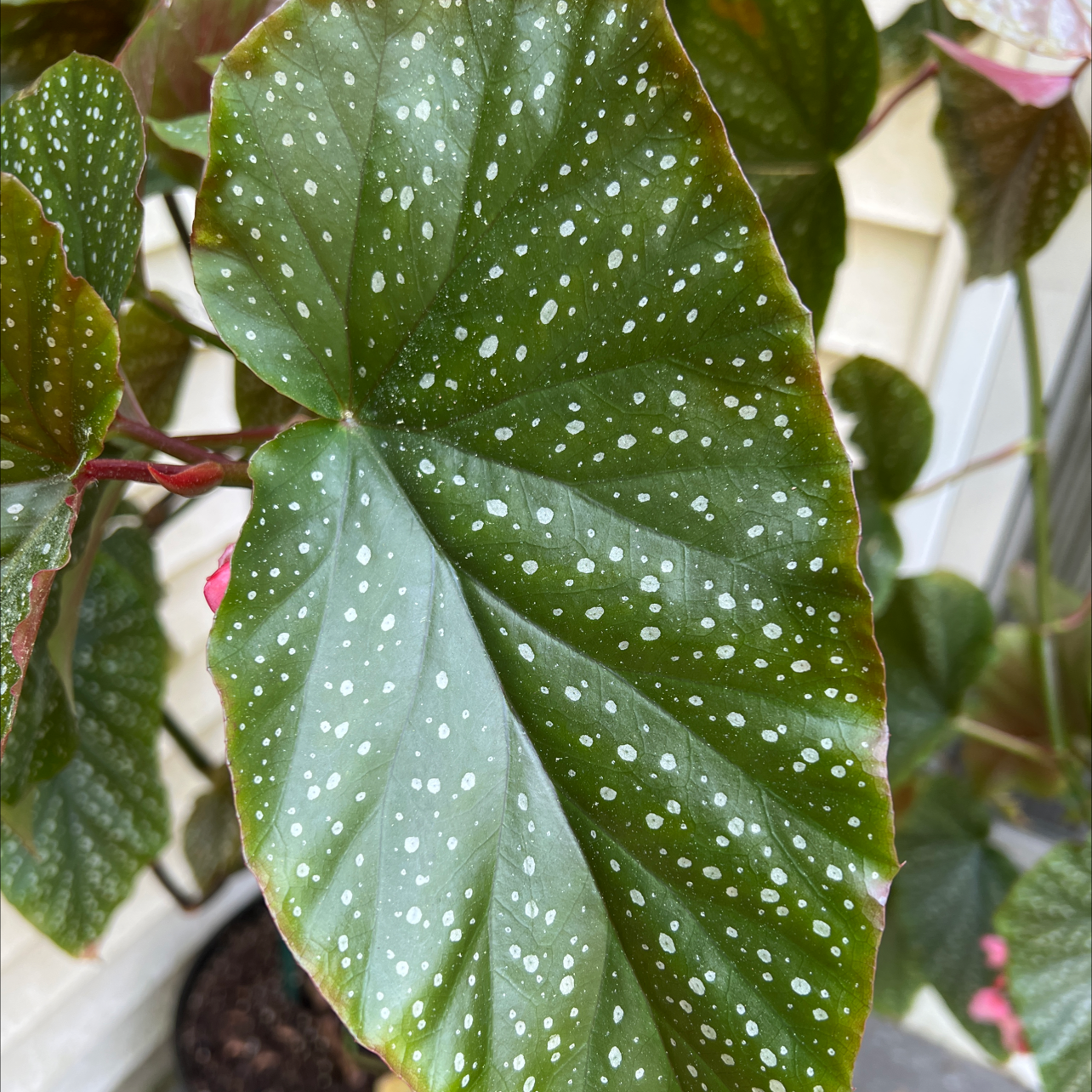
What's Wrong with My Polka Dot Begonia?

Common Polka Dot Begonia Problems
Brown leaf edges
Begonia maculata's large, silver-spotted leaves transpire heavily and need 50–60%+ humidity to stay healthy. In dry indoor air, the leaf margins brown and crisp first because the tissue at the edges is furthest from the central water supply along each leaf's thick, waxy surface.
When the soil dries out completely, Begonia maculata's relatively thin leaves lose water faster than the roots can replace it. The edges brown and go papery before the rest of the leaf shows stress, because the margins are the last stop on the plant's water distribution route.
Yellow leaves
Begonia maculata grows from a shallow, fibrous root system that suffocates quickly in waterlogged soil. When the roots rot, the plant pulls nutrients back from the oldest leaves first. Yellowing starts at the base of the canes and works upward, with soil that stays wet long after watering.
As Begonia maculata grows taller along its canes, the oldest lower leaves yellow and drop off naturally. This is normal for a cane-forming begonia. If only the bottom one or two leaves are yellowing and the cane tips are pushing out fresh spotted growth, nothing is wrong.
Dropping leaves
Begonia maculata is sensitive to abrupt environmental change. A cold draft from a window or AC vent, or moving the plant to a new spot, can trigger rapid leaf drop within a day or two. The cane-forming stems hold leaves at nodes, and those nodes release leaves quickly under stress.
Root rot from overwatering cuts off water delivery to every part of the plant. Begonia maculata drops leaves from the lower canes first as the plant sheds tissue it can no longer support. The soil will feel wet or smell sour if this is the cause.
White powder on leaves
Begonias are among the most powdery-mildew-prone houseplants. The white dusty coating is a fungal infection that spreads across Begonia maculata's silver-spotted leaves in conditions with poor airflow and stagnant humidity. It looks like someone dusted flour on the surface and spreads leaf to leaf if left alone.
Leggy growth
Begonia maculata grows naturally as a tall, upright cane and will keep stretching upward indefinitely without intervention. The lower canes go bare and the spotted leaves cluster only at the top, making the plant look sparse. Regular pinching is what keeps this species looking full and bushy rather than like a bare stick with a tuft.
Pests
Mealybugs are the most common pest on Begonia maculata. They hide in the tight leaf axils where the spotted leaves attach to the canes, making them easy to miss until a heavy infestation is underway. The white cottony masses and sticky honeydew dripping down the canes are the telltale signs.
Dry indoor air invites spider mites, and Begonia maculata's large, succulent-feeling leaves are a prime target. Fine webbing at the stem joints and pale stippled speckling on the upper surface of the spotted leaves are the first signs. Mite populations build fast in heated indoor rooms in winter.
Preventing Polka Dot Begonia Problems
About This Article
