What's Wrong with My Rattlesnake Plant?

Common Rattlesnake Plant Problems
Brown leaf edges
Rattlesnake Plant is notoriously sensitive to fluoride, chlorine, and dissolved salts in tap water. These minerals accumulate at the leaf margins, where water evaporates, and kill the cells there. The long wavy-edged leaves show this damage in a distinctive crispy brown border that traces the entire leaf outline.
Native to the humid floor of Brazilian rainforests, Rattlesnake Plant expects 50–60%+ humidity. When indoor air is dry, moisture evaporates from the leaf edges faster than the roots can supply it. The long leaves with their wavy margins are especially vulnerable because those ruffled edges are the last tissue to get water from the stem.
Curling leaves
Rattlesnake Plant's leaves roll inward lengthwise when the soil goes dry. The plant tightens the long wavy leaf into a loose tube to cut down on water loss through the surface. All leaves tend to curl at once because the whole plant draws from the same root system.
Dry air causes the same rolling response as underwatering, and the two problems often stack. The Rattlesnake Plant's long leaves lose moisture across a large surface area, and the curl is the plant's attempt to protect itself. If the soil is moist but leaves are still curling, humidity is the culprit.
Yellow leaves
Rattlesnake Plant grows from a shallow rhizome that sits close to the soil surface and rots quickly in waterlogged conditions. When the rhizome and roots start to break down, the plant stops moving nutrients up through the leaves and they yellow, starting with the oldest ones at the outside of the clump.
Rattlesnake Plant occasionally retires its oldest outer leaves as new ones emerge from the center. A single yellowing leaf at the outside of the clump while the rest of the plant looks healthy is normal turnover, not a problem.
Fading leaf pattern
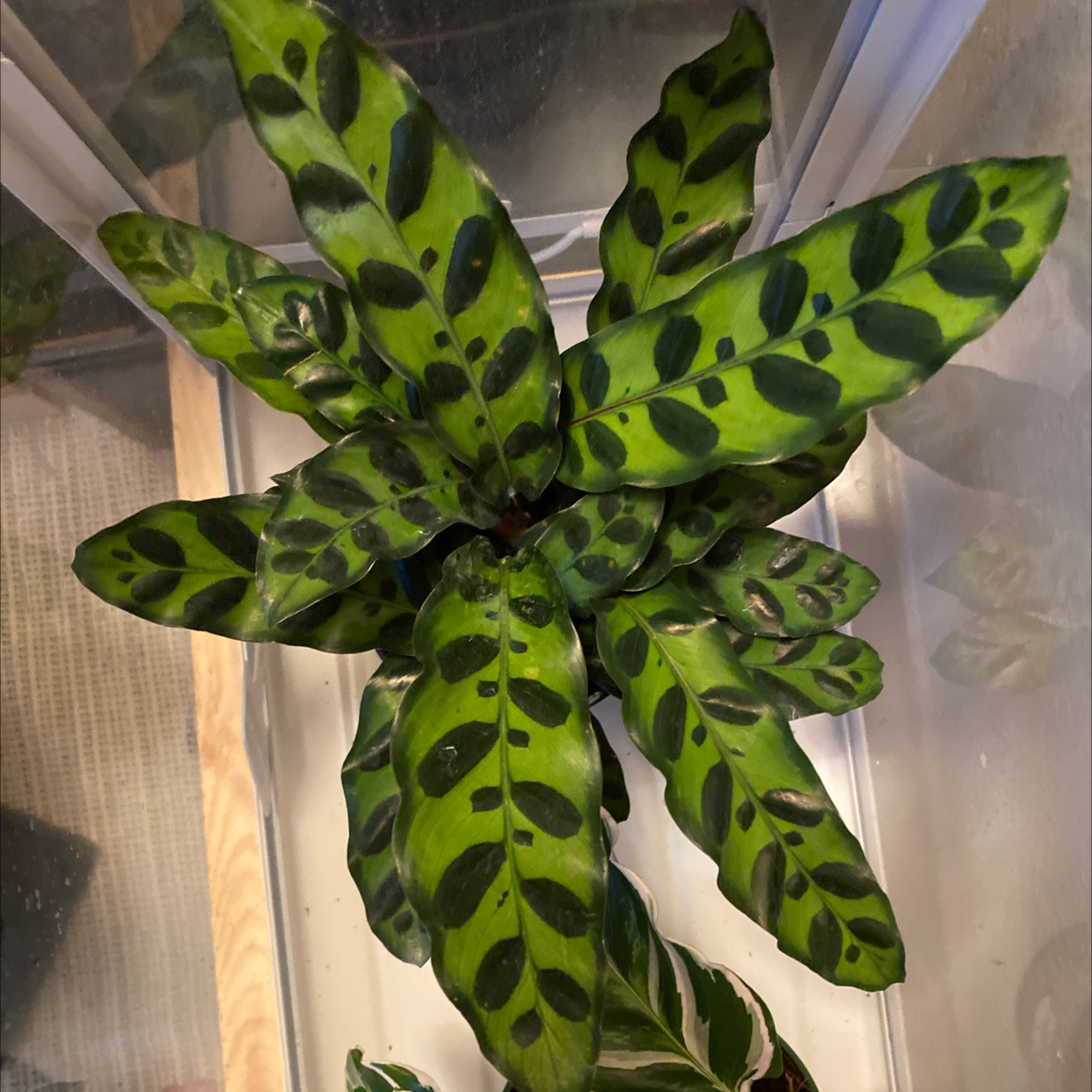
The Rattlesnake Plant's signature look is dark green oval spots on a pale green background, with rich purple undersides. The plant produces more pigment under adequate light. In deep shade, new leaves come in with washed-out, faint markings because the plant doesn't invest in pigment it cannot use for photosynthesis.
Leaves not folding at night
Rattlesnake Plant folds its leaves upright at night using tiny motor cells at the base of each leaf stem that swell and contract with water pressure. When the plant is stressed by drought, dry air, low light, or root damage, those cells don't have enough water pressure to move the leaves. The folding stops before other symptoms appear, making it an early warning signal.
Pests
Spider mites thrive in dry air, and Rattlesnake Plant's demand for high humidity is rarely met in most homes. Fine webbing along the underside of the long leaves and pale stippling across the top surface are the signs. The mites hide in the grooves between the wavy leaf edges and along the midrib, so infestations grow large before they are obvious.
Tiny black flies hovering around the soil signal fungus gnats. Their larvae feed in the top inch of moist potting mix. Because Rattlesnake Plant needs consistently moist soil and high humidity, the conditions that keep it healthy are also ideal for gnat breeding.
Preventing Rattlesnake Plant Problems
About This Article
