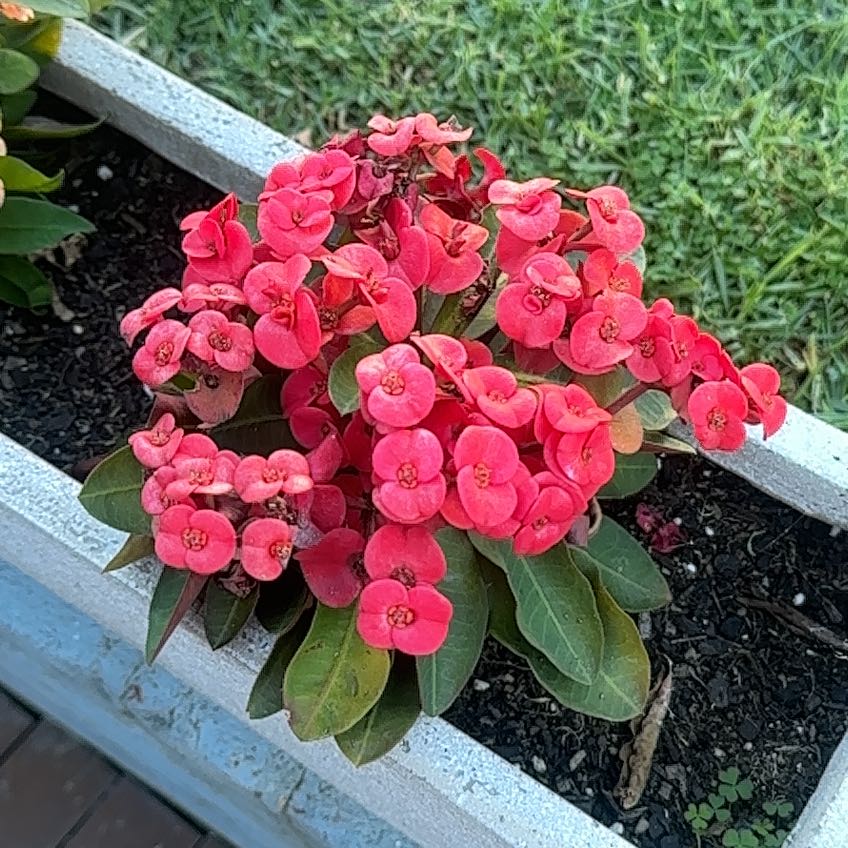
Crown of Thorns

What's Wrong with My Crown of Thorns?

Euphorbia milii
Reviewed by Kiersten Rankel M.S.
Quick Answer
1.
Leaf drop is almost always stress, not death.
Crown of Thorns sheds its leaves at the first sign of trouble. A move, a temperature drop, overwatering, or a missed watering can all trigger a bare plant overnight. New leaves regrow quickly once conditions settle, and the thorny stems stay firm and alive even when completely bare.
2.
No flowers means not enough light.
This plant needs several hours of direct sun each day to bloom. Low light is the most common reason it sits there green and flowerless for months. Move it to the sunniest window you have.
3.
New bract clusters mean it's bouncing back.
Small red, pink, or yellow bracts forming at the branch tips, or fresh small leaves pushing out, mean the plant is recovering. Even a bare plant with new tip growth is on its way back.
Stay on top of plant care
Get seasonal reminders for watering and fertilizing โ€” personalized for your plants.
Try Greg Free

Common Crown of Thorns Problems

Leaf drop

Stress from any change

Crown of Thorns drops leaves reactively as a survival reflex. Any disruption, including moving the pot, repotting, a cold draft, a missed watering, or a change in light level, can trigger the plant to shed its sparse oval leaves almost overnight. The stems stay firm and alive. New leaves regrow within weeks once conditions stabilize, so a bare plant is not a dead plant.

1. Identify what changed recently. Look for a move, a cold window, uneven watering, or a recent repotting
2. Stabilize the plant in a warm, sunny spot and resume a consistent watering schedule
3. Wait two to four weeks without moving the plant again. New leaves will push out from the tips once it settles
Overwatering

Crown of Thorns is a succulent shrub adapted to dry rocky slopes in Madagascar. Its thick, water-storing stems rot when the soil stays soggy, and the first sign is often sudden leaf drop paired with yellowing. Unlike stress drop, the stems may feel soft at the base if root rot has set in.

1. Check the soil. If it is wet or damp, stop watering immediately
2. Let the pot dry out completely before watering again
3. Press the base of the stem. If it feels firm, the plant will recover. If it is soft or blackened, the rot has reached the stem

No flowers

Insufficient light

Crown of Thorns blooms nearly year-round when given several hours of direct sun each day, reflecting its origin in the bright, exposed scrublands of Madagascar. In low or indirect light indoors, it conserves energy and stops producing the small colorful bracts that look like flowers. The stems stay green but growth slows and blooms disappear.

1. Move the plant to the brightest spot available, ideally a south or west window with direct sun for at least three to four hours a day
2. If the plant was recently moved or repotted, give it four to six weeks to settle before expecting flowers to return
3. Outdoors in warm months, full sun is ideal and will trigger the most prolific blooming
Stress or recovery from a move

After any disturbance, Crown of Thorns redirects energy away from flowering and into stabilizing. A plant that just dropped its leaves and is pushing new growth has not yet returned its energy budget to blooming. Flowers follow once the plant feels settled.

1. Leave the plant undisturbed in its new spot for at least a month
2. Once fresh leaves and new tip growth appear, flowers usually follow within a few weeks

Yellow leaves

Overwatering

When Crown of Thorns sits in wet soil, its shallow roots suffocate and begin to rot. The plant pulls nutrients back from leaves as the root system fails, and the oldest leaves turn yellow and drop first. The pattern works from the bottom of the stem upward.

1. Stop watering immediately and let the soil dry out completely
2. If yellowing continues after the soil has dried, press the base of the stem to check for soft tissue, which signals rot has spread beyond the roots
3. Repot into dry, gritty cactus mix with excellent drainage if you find soft, dark roots
Normal shedding

Crown of Thorns naturally sheds older leaves from the lower stems as the plant matures, directing energy to new tip growth and blooming. If only one or two older leaves at the base are yellowing and the rest of the plant looks fine, this is not a problem.

Mushy stem base

Root rot climbing the stem

When Crown of Thorns stays in waterlogged soil, rot travels from the roots into the thick woody stems. The base goes soft and dark. At that point the rootball is gone. Handle the plant carefully during any inspection because the milky sap that oozes from cut stems is an irritant that can cause skin rashes and eye irritation.

1. Put on gloves before handling. Cut stem sections from the highest firm, healthy part of the plant
2. Set the cuttings aside in a dry, shaded spot for two to three days until the cut end forms a callus and the sap dries
3. Press the calloused end into dry, gritty cactus mix and do not water for the first week
4. Discard the original rotted rootball

Pests

Mealybugs

White cottony clusters hidden in the joints between the thorny stem and leaves, and tucked against the spines. Crown of Thorns' dense, thorned stems create hard-to-reach crevices where mealybug colonies build up unnoticed. They suck sap and leave sticky honeydew on the stems below.

1. Put on gloves. Dab each white cluster with a cotton swab soaked in 70% isopropyl alcohol
2. Follow with a spray of insecticidal soap over the whole plant, working into every stem joint
3. Repeat every five to seven days for three weeks to catch newly hatched eggs
Scale

Small brown or tan waxy bumps on the woody stems, often blending in with the bark-like texture of older Crown of Thorns canes. Scale insects pierce the stem and suck sap, leaving yellowed patches and sticky residue. They are easily missed on a plant this textured.

1. Scrape the bumps off carefully with a soft toothbrush, working between the thorns
2. Wipe stems down with a cloth dampened in 70% isopropyl to kill remaining crawlers
3. Check weekly for a month and repeat if new bumps appear

Preventing Crown of Thorns Problems

A few consistent habits prevent most of what goes wrong with Crown of Thorns.
Monthly Check
1
Water only when the soil is fully dry.
Crown of Thorns evolved in dry, rocky soil and is far more drought-tolerant than it is rot-tolerant. Waiting until the pot feels light and the soil is bone dry before watering prevents the soggy conditions that cause leaf drop, yellowing, and stem rot.
2
Pot in a gritty, fast-draining cactus mix with a drainage hole.
Dense potting soil holds too much moisture for this plant. A cactus or succulent mix with added perlite drains quickly and lets the roots dry between waterings, which is the single best defense against root rot.
3
Give it the sunniest spot you have.
Direct sun for at least three to four hours a day keeps Crown of Thorns blooming and its growth compact. Low light leads to leaf drop, sparse growth, and no flowers.
4
Keep it in one spot and avoid cold drafts.
This plant drops leaves whenever it senses a change. Temperatures below 50ยฐF and cold air from windows or vents trigger stress drop. A stable, warm, sunny position reduces the most common disruptions.
5
Wear gloves when pruning or repotting.
The milky sap that oozes from cut stems is a skin and eye irritant. Gloves and caution during any handling prevents the rash and irritation the sap can cause.
Stay on top of plant care
Get seasonal reminders for watering and fertilizing โ€” personalized for your plants.
Try Greg Free

About This Article

Kiersten Rankel M.S.
Botanical Data Lead at Greg ยท Plant Scientist
About the Author
Kiersten Rankel holds an M.S. in Ecology & Evolutionary Biology from Tulane University. A certified Louisiana Master Naturalist, she has over a decade of experience in science communication, with research spanning corals, cypress trees, marsh grasses, and more. At Greg, she curates species data and verifies care recommendations against botanical research.
See Kiersten Rankel's full background on LinkedIn.
Editorial Process
Every problem and fix in this article was verified against Greg's botanical database, cross-referenced with USDA hardiness zone data and published horticultural research from World of Succulents and Missouri Botanical Garden. The Euphorbia milii care profile reflects 6,400+ Greg users growing this species both indoors as a blooming accent and outdoors in zones 9โ€“11, alongside peer-reviewed sources on Euphorbiaceae cultivation.
6,546+ Greg users growing this plant
USDA hardiness zones 9aโ€“11b