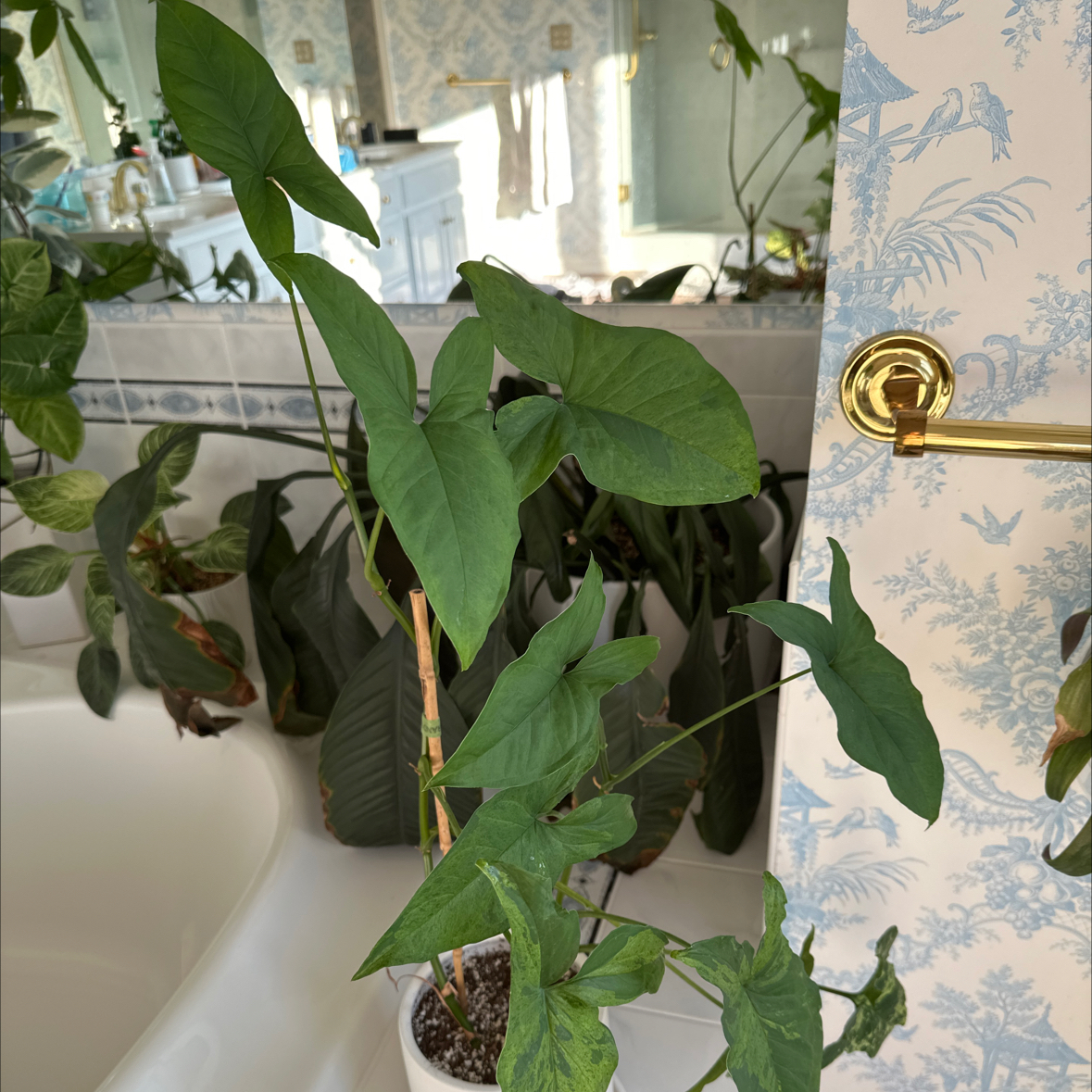
What's Wrong with My Arrowhead Plant?

Common Arrowhead Plant Problems
Yellow leaves
Syngonium roots are fine and prefer to dry slightly between waterings. Sitting in soggy soil cuts off oxygen and the roots rot, leaving the plant unable to move nutrients up to its leaves. It pulls energy back from the oldest leaves first, so yellowing starts at the base and climbs the stem.
As the Arrowhead Plant pushes new growth at its tips, it drops the oldest leaves near the base. One or two yellowing lower leaves on an otherwise healthy plant with active new growth at the tips is normal energy reallocation.
Brown tips
Syngonium podophyllum is native to the humid tropical forests of Central and South America. Its thin, arrow-shaped leaves lose moisture through their tips and edges faster than thicker-leaved houseplants, so crispy brown tips appear first when indoor air drops below 40%. Heating vents and air conditioning accelerate the problem.
Arrowhead Plant is sensitive to fluoride and chlorine in tap water. These accumulate in the leaf tips over time and cause the edges to brown and die, even when watering frequency and humidity are on point. The tips are the last stop for water moving through the leaf, so mineral buildup concentrates there.
Leggy stems
Young Arrowhead Plants stay compact and upright in bright indirect light. In dim conditions, the vining stems stretch and elongate between nodes, producing small pale leaves with long bare sections. Mature plants become leggy-vining naturally, but low light accelerates it and weakens the growth. The plant is reaching, not thriving.
Fading variegation
The pink, white, and cream zones in variegated Syngonium cultivars are cells with reduced chlorophyll. In dim conditions, the plant produces more chlorophyll to compensate, and new leaves emerge progressively greener. Existing faded leaves will not recover their color, but variegation returns on new growth once the plant gets more light.
Pests
Fine webbing on leaf undersides and pale stippling across the surface are the signs. Dry indoor air invites spider mites, and they spread quickly across Syngonium's vining stems when leaves are crowded. The arrow-shaped leaves can hide early webbing, so check the undersides closely before the infestation advances.
White cottony clumps tucked into leaf axils and where new leaves emerge from the stem. Syngonium's dense node clusters give mealybugs cover, and they build up over several weeks before the infestation becomes obvious. They leave sticky honeydew trails on stems and nearby leaves.
Flat brown or tan bumps clinging to stems and the undersides of leaves. Scale insects have a hard waxy shell that protects them from sprays, and they feed on sap along the Syngonium's stem nodes where growth is most active. Heavy infestations cause stunted, yellowing new growth.
Preventing Arrowhead Plant Problems
About This Article
