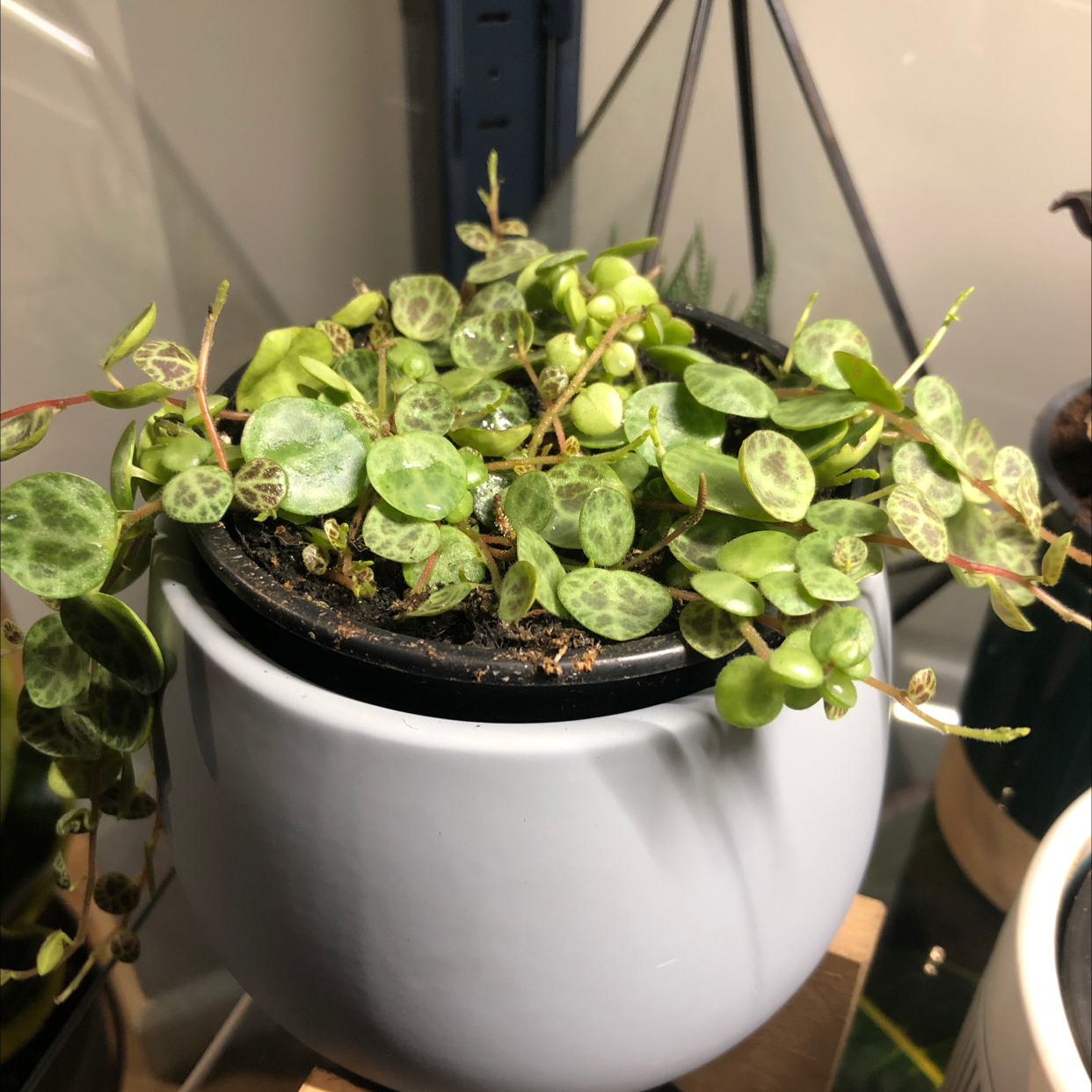
String of Turtles does best in a small, shallow pot made of unglazed ceramic or terracotta with drainage holes. Keep the pot just 1-2 inches wider than the root ball. These tiny roots rot easily, so fast drainage is more important than anything else.
What Size Pot Does a String of Turtles Need?
String of Turtles has a very small, shallow root system that only needs a few inches of soil depth. A compact, shallow pot is ideal. Choose a pot just 1-2 inches wider than the root clump, and no deeper than 3-4 inches for young plants.
This is a slow grower that stays small, reaching only about 4 inches tall with trailing stems spreading to about 12 inches. You will not need to size up often. Overpotting is the most common mistake with this plant since the excess damp soil quickly overwhelms its tiny roots.
A wide, shallow dish or low-profile pot shows off the trailing stems beautifully while keeping the soil volume matched to the root mass.
Small cutting or starter (under 3")2–3" shallow pot
Young plant (3–6" spread)3–4" shallow pot
Mature trailing plant (6–12" spread)4–5" shallow pot or dish
What Material Pot Is Best for String of Turtles?
String of Turtles has delicate, semi-succulent roots that store a small amount of moisture. These roots need to dry out between waterings or they rot quickly. A breathable pot that wicks moisture away from the root zone is the safest choice.
Because the root system is so small, even a slight excess of moisture can cause problems. Prioritize fast drying over moisture retention when choosing a pot material.
Dries fastest → Slowest
Best for String of Turtles
Fabric
Dries very quickly, which these tiny roots appreciate. Check moisture often since it can dry too fast in warm rooms.
Unglazed Ceramic
The best all-around choice. Breathes well, dries evenly, and looks great with a small trailing plant.
Wood
Good airflow, though small wood pots are less common. Works well if you can find a shallow wooden planter.
Glazed Ceramic
Holds moisture longer than unglazed, so water less frequently and make sure drainage holes are clear.
PlasticTOO SLOW
Retains moisture too long for these rot-prone roots. If using plastic, mix extra perlite into the soil.
Best for String of Turtles
Metal
Fine for indoor display. The small pot size means temperature swings are minimal indoors.
String of Turtles has tiny, delicate roots that rot easily in soggy soil. Unglazed ceramic is the best all-around choice, offering steady airflow and even drying in a size that suits this small trailing plant. Fabric works well too, though check the soil often since it can dry out fast.
Avoid plastic pots. They hold moisture too long for these rot-prone roots. If plastic is all you have, add extra perlite to the soil mix and water less frequently.
Stay on top of plant care
Get seasonal reminders for watering and fertilizing — personalized for your plants.
Absolutely yes. String of Turtles is one of the plants most sensitive to overwatering. Its tiny semi-succulent roots rot quickly in standing water. A drainage hole is not optional for this one.
Because the pots are small, even a tablespoon of trapped water can saturate the entire root zone. Make sure the drainage hole is not blocked by compacted soil. A thin layer of coarse perlite at the bottom helps water flow freely.
When Should I Repot My String of Turtles?
String of Turtles is a slow grower and rarely needs repotting more than once every two to three years. It is perfectly happy being root-bound, so only repot when the soil has broken down or the roots have completely filled the pot.
Repot in spring or early summer. Handle the plant gently since the stems are fragile and snap easily. Tip the pot sideways to slide the plant out rather than pulling on the vines.
Use a very fast-draining mix. A succulent or cactus blend with extra perlite (about 50/50) keeps the small root zone airy. Regular potting soil holds too much moisture for this plant.
Signs It's Time to Repot
Soil breaks down and stays mushy after watering
Roots visible through the drainage hole of a tiny pot
Plant growth stalls completely for a full growing season
Water sits on the soil surface instead of draining through
When Can I Plant My String of Turtles in the Ground?
String of Turtles is tropical and only survives outdoors year-round in zones 10a through 12b. Even in these zones, plant it in a sheltered, shaded spot with very well-draining soil. It is native to the rainforest floor in Ecuador and cannot handle direct sun or dry wind.
For almost everyone, this plant belongs in a small indoor pot. It does not tolerate any frost and will die at temperatures below about 50 degrees F. Keep it as a houseplant and enjoy the trailing stems from a shelf or hanging planter.
Got More Questions?
Can I use a pot without drainage holes for String of Turtles?
No. This is one of the worst plants to grow without drainage. Its tiny roots rot within days of sitting in standing water. Always use a pot with a hole, no exceptions.
How do I know if my String of Turtles pot is too big?
If the soil stays damp for more than a week, or if the pot is more than 2 inches wider than the root clump, it is too large. Downsize to a smaller pot to protect the roots from excess moisture.
Why are my String of Turtles stems mushy at the soil line?
This is almost always caused by too much moisture at the base. The pot may be too large, the soil too dense, or drainage too slow. Repot into a smaller pot with fast-draining mix and cut away any rotted stems.
Should I use a hanging pot or a regular pot?
Either works. A small pot on a high shelf or in a hanging planter lets the delicate trailing stems cascade naturally. Just make sure whichever pot you choose has drainage and is not oversized.
Can I group String of Turtles with other plants in one pot?
Be cautious. String of Turtles needs much less water than most houseplants. Only pair it with plants that have similar low-water needs, like other small Peperomia species. Even then, the pot must drain well.
Stay on top of plant care
Get seasonal reminders for watering and fertilizing — personalized for your plants.
Kiersten Rankel holds an M.S. in Ecology & Evolutionary Biology from Tulane University. A certified Louisiana Master Naturalist, she has over a decade of experience in science communication, with research spanning corals, cypress trees, marsh grasses, and more. At Greg, she curates species data and verifies care recommendations against botanical research.
See Kiersten Rankel's full background on LinkedIn.
Editorial Process
Container guidance verified against Peperomia prostrata growth data from Greg's botanical database, cross-referenced with USDA hardiness zone data and published horticultural research.