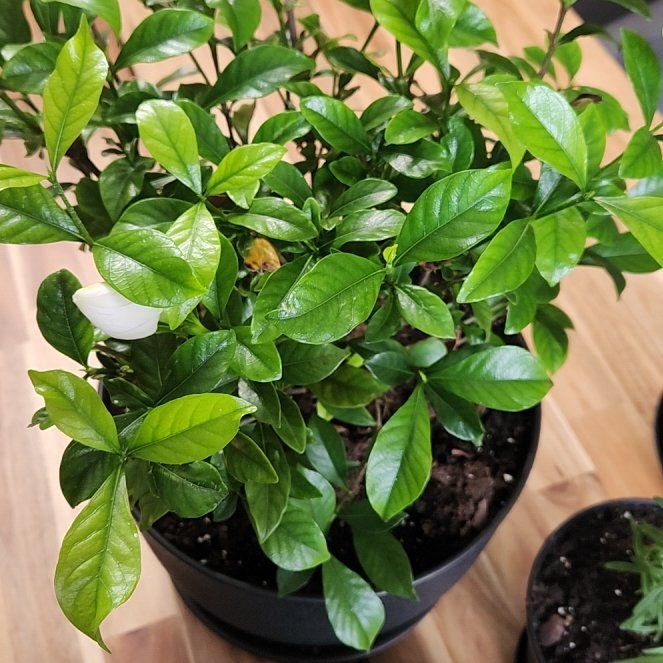
Gardenia augusta 'Florida'

How to Fertilize Gardenia augusta 'Florida'

Gardenia jasminoides 'Florida'
Reviewed by Kiersten Rankel M.S.
Quick Answer
Use an acidic fertilizer formulated for gardenias or azaleas, such as a 4-3-4 or similar acid-forming blend. Feed every two to four weeks from spring through late summer. Stop fertilizing in fall and winter when the plant rests.

When Should I Start Feeding My Gardenia?

Your feeding schedule depends on your local climate, since gardenias break dormancy earlier in warmer regions and later where spring frosts linger.

US feeding regions map
Pacific Feb–Oct
Mountain May–Aug
Midwest May–Sep
Northeast May–Sep
Southeast Mar–Oct
Stay on top of plant care
Get seasonal reminders for watering and fertilizing — personalized for your plants.
Try Greg Free

How Often Should I Fertilize My Gardenia?

Feed your Gardenia every two to four weeks during the active growing season, from spring through late summer. Use half-strength liquid fertilizer for container plants and full-strength granular for garden beds.

Taper off in early fall and stop entirely by mid-fall. Gardenias enter a rest period in winter and do not need fertilizer when growth slows.

If you notice yellowing between the leaf veins, your soil pH may be too high. A dose of chelated iron or a soil acidifier can help, but this is a pH issue, not a fertilizer deficiency.

Feeding Calendar
Spring & Summer
Half-strength acid fertilizer every 2–4 weeks
Early Fall
One final light feeding, then stop
Late Fall & Winter
No feeding

What Is the Best Fertilizer for Gardenia?

Gardenias are acid-loving plants that need a fertilizer designed to lower soil pH. Look for a formula labeled for gardenias, azaleas, or camellias with an NPK ratio around 4-3-4 or 6-4-6. These blends include sulfur and iron, which keep the soil acidic and prevent yellow leaves.

A liquid acid-forming fertilizer is the easiest option for potted gardenias because it delivers nutrients quickly and evenly. Dilute to half the label strength to avoid salt buildup in the container.

For in-ground gardenias, a slow-release granular acid fertilizer applied in early spring gives steady nutrition for several months. Supplement with a liquid feed once a month during peak bloom if flowers seem sparse.

Synthetic
Acid-forming powder that dissolves in water. Mix 1 tablespoon per gallon and apply every two weeks during the growing season.
Convenient liquid dropper formula. Seven drops per quart of water makes feeding quick and consistent.
Organic
Granular organic fertilizer with sulfur for acid-loving plants. Apply every 4 weeks during the growing season.
Organic blend with cottonseed meal and elemental sulfur that slowly acidifies the soil. Work into the top inch of soil.
Contains beneficial microbes and is gentle enough for container gardenias. Apply once a month.

How Do I Fertilize My Gardenia?

1
Water your plant first
Give your Gardenia a thorough watering before you fertilize. Moist soil protects the roots from chemical burn.
2
Measure and dilute
Mix your acid-forming liquid fertilizer at half the label rate. For granular products, measure according to the package and scatter evenly.
3
Apply around the drip line
Pour the diluted liquid slowly around the base of the plant, avoiding the leaves. For granular fertilizer, spread it in a ring around the drip line and water it in.
4
Check soil pH periodically
Gardenias need acidic soil (pH 5.0 to 6.0). Test your soil once or twice a season and apply a soil acidifier if the pH creeps above 6.0.
5
Flush the soil every few months
For potted gardenias, water deeply until it runs out the drainage holes to wash out accumulated salts from fertilizer.

Got More Questions?

Can I use coffee grounds to fertilize my Gardenia?
Coffee grounds are slightly acidic and gardenias do appreciate acidic soil, so a thin layer scratched into the topsoil can help. However, coffee grounds alone do not provide enough nutrients. Use them as a supplement, not a replacement for a proper acid fertilizer.
What happens if I over-fertilize my Gardenia?
Over-fertilizing causes brown, crispy leaf edges and can burn the roots. If you see salt crust on the soil surface, flush the pot with plenty of water to rinse out excess salts. Skip the next one or two feedings to let the plant recover.
Why are my Gardenia's leaves turning yellow between the veins?
This is called interveinal chlorosis and it usually means the soil pH is too high for your Gardenia to absorb iron. Apply a chelated iron supplement and use an acid-forming fertilizer to gradually lower the pH.
Should I fertilize my Gardenia while it's blooming?
Yes, gardenias benefit from regular feeding while they bloom. Just stick to half-strength liquid fertilizer so you do not stress the roots during flowering.
Can I use general-purpose fertilizer on my Gardenia?
It will work in a pinch, but general-purpose fertilizers do not acidify the soil. Over time your Gardenia may develop nutrient deficiencies because the soil pH drifts too high. An acid-specific formula is always the better choice.
Stay on top of plant care
Get seasonal reminders for watering and fertilizing — personalized for your plants.
Try Greg Free

About This Article

Kiersten Rankel M.S.
Botanical Data Lead at Greg · Plant Scientist
About the Author
Kiersten Rankel holds an M.S. in Ecology & Evolutionary Biology from Tulane University. A certified Louisiana Master Naturalist, she has over a decade of experience in science communication, with research spanning corals, cypress trees, marsh grasses, and more. At Greg, she curates species data and verifies care recommendations against botanical research.
See Kiersten Rankel's full background on LinkedIn.
Editorial Process
Fertilizer recommendations verified against Gardenia jasminoides 'Florida' growth data from Greg's botanical database, cross-referenced with USDA hardiness zone data and published horticultural research.
42+ Greg users growing this plant
USDA hardiness zones None–None