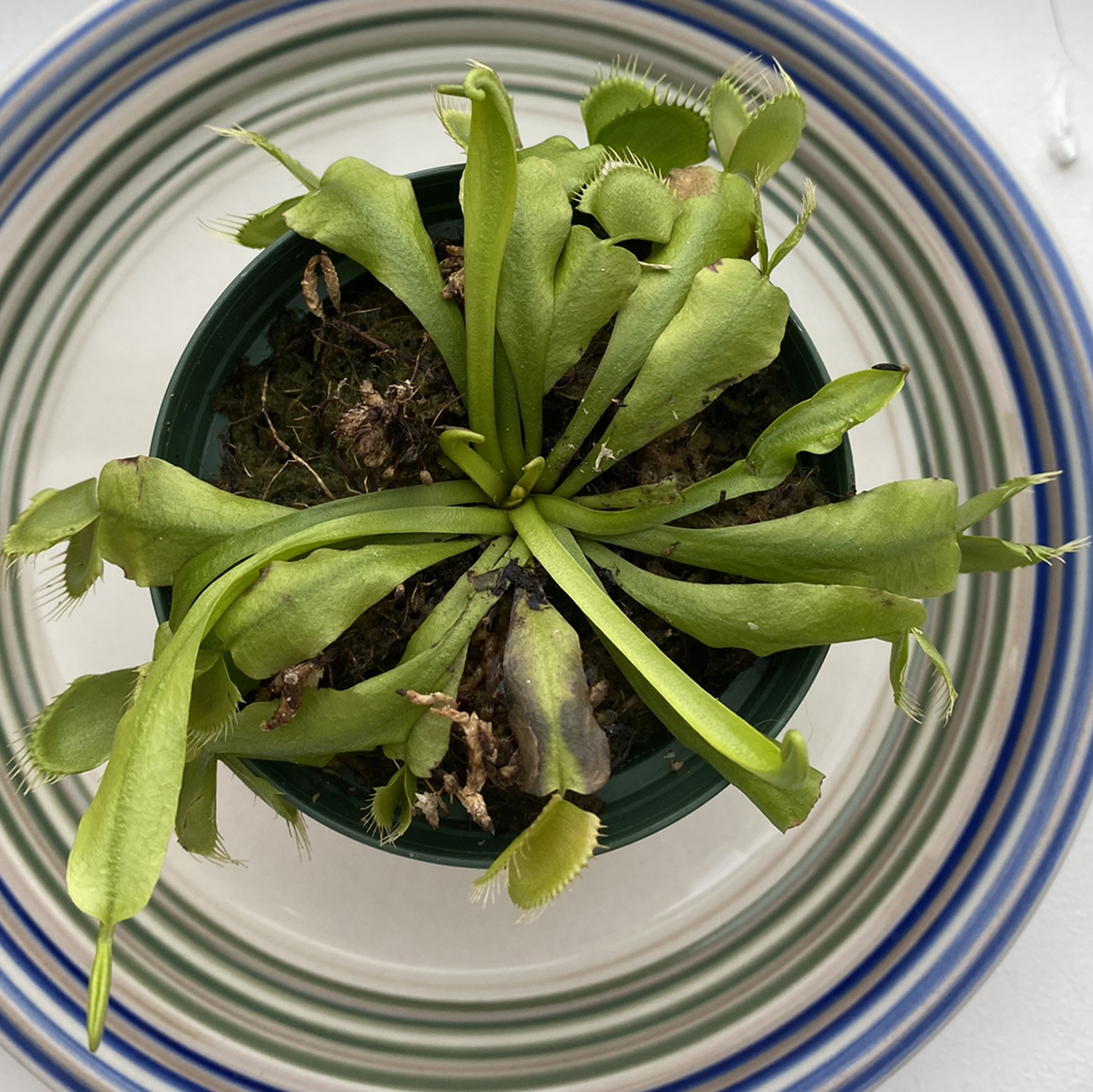
Venus Fly Trap

How to Fertilize Venus Fly Trap

Dionaea muscipula
Reviewed by Kiersten Rankel M.S.
Quick Answer
Venus Fly Traps rarely need fertilizer. They get nutrients from catching insects. If your plant has no bugs, mist leaves with MaxSea 16-16-16 at quarter strength monthly in summer.

When Should I Start Feeding My Venus Fly Trap?

Venus Fly Trap is native to a narrow coastal zone in the Carolinas (zones 6a-8b), and its feeding season follows the warm, bright months when traps are actively growing.

US feeding regions map
Pacific May–Sep
Mountain Jun–Aug
Midwest Jun–Aug
Northeast Jun–Aug
Southeast May–Sep
Stay on top of plant care
Get seasonal reminders for watering and fertilizing — personalized for your plants.
Try Greg Free

How Often Should I Fertilize My Venus Fly Trap?

If your Venus Fly Trap catches insects regularly (even a few per month), skip fertilizer entirely. The plant handles its own nutrition through the traps. Feeding it insects is always better than applying any chemical solution.

If the plant is grown in a sealed terrarium or has no access to bugs, a light foliar spray once a month during summer is sufficient. That means roughly 3-4 applications per year at most.

Stop all fertilizer by early fall. Venus Fly Traps need a cold winter dormancy, and any feeding during this period can weaken or kill the plant.

Feeding Calendar
Spring
No fertilizer needed as traps begin reopening
Summer
Optional foliar spray of quarter-strength MaxSea once a month
Early Fall
Stop all feeding as growth slows
Late Fall & Winter
No feeding during required cold dormancy

What Is the Best Fertilizer for Venus Fly Trap?

Venus Fly Traps evolved in nutrient-poor bogs and are extremely sensitive to minerals in the soil. Standard fertilizers will burn and kill the roots. If you fertilize at all, use only a foliar spray applied to the leaves, never the soil.

The most trusted option among carnivorous plant growers is MaxSea 16-16-16, a seaweed-based fertilizer, diluted to quarter strength (about 1/4 teaspoon per gallon). Spray it lightly on the leaves once a month during the growing season.

The best approach, though, is simply letting the plant catch its own food. A few small insects per month give it all the nutrition it needs.

Synthetic
Seaweed-based powder that is safe as a foliar spray for carnivorous plants at quarter strength. The most widely recommended option by carnivorous plant growers.
Some growers place 2-3 individual pellets directly into open traps as a substitute for insects. This is an advanced technique. Do not scatter on soil.
Organic
Rehydrate a single bloodworm and drop it into an open trap. Triggers the digestion response just like a live insect. Sold in the fish food aisle.
Rehydrate a small dried cricket and place it in a trap. One feeding per trap every 2-4 weeks during summer is plenty.

How Do I Fertilize My Venus Fly Trap?

1
Choose foliar spray only
Never pour fertilizer into the soil. Venus Fly Trap roots are adapted to mineral-free bog conditions. Use a fine mist sprayer for leaf application only.
2
Dilute to quarter strength
Mix MaxSea 16-16-16 at one-quarter the label rate, about 1/4 teaspoon per gallon of distilled or rain water. Using tap water defeats the purpose since minerals in tap water harm the plant.
3
Mist the leaves lightly
Spray a light, even mist on the leaves and trap surfaces. You want them damp, not dripping. Avoid saturating the soil.
4
Apply in the morning
Spray in the morning so the leaves dry before nightfall. Wet foliage overnight can encourage fungal problems on these moisture-sensitive plants.
5
Consider feeding insects instead
Dropping a small, freshly killed insect (like a cricket or fly) into an open trap every few weeks gives the plant everything it needs without any risk of mineral damage. This is the safest and most natural fertilizing method.

Got More Questions?

Can I use coffee grounds on my Venus Fly Trap?
Absolutely not. Coffee grounds add minerals to the soil that are toxic to Venus Fly Traps. These plants evolved in nutrient-free bogs and cannot tolerate any soil amendments.
What happens if I over-fertilize my Venus Fly Trap?
The roots will burn and turn black, and the plant will decline rapidly. If you accidentally get fertilizer in the soil, flush it immediately with distilled water, several times over. Even small amounts of minerals can be fatal.
Can I feed my Venus Fly Trap raw meat or hamburger?
No. Raw meat rots before the trap can digest it, causing the trap to turn black and die. Only feed it whole insects or rehydrated freeze-dried bugs that the trap can fully break down.
Does my Venus Fly Trap need fertilizer if it catches bugs?
No. A plant that catches even a few insects per month gets all the nutrients it needs. Additional fertilizer on top of natural feeding is more likely to cause harm than help.
Why are my Venus Fly Trap's traps turning black after I fertilized?
Black traps after fertilizing usually mean the roots absorbed too many minerals from soil contact. Switch to foliar spray only and flush the soil with distilled water. The plant may recover if the root damage is not too severe.
Stay on top of plant care
Get seasonal reminders for watering and fertilizing — personalized for your plants.
Try Greg Free

About This Article

Kiersten Rankel M.S.
Botanical Data Lead at Greg · Plant Scientist
About the Author
Kiersten Rankel holds an M.S. in Ecology & Evolutionary Biology from Tulane University. A certified Louisiana Master Naturalist, she has over a decade of experience in science communication, with research spanning corals, cypress trees, marsh grasses, and more. At Greg, she curates species data and verifies care recommendations against botanical research.
See Kiersten Rankel's full background on LinkedIn.
Editorial Process
Fertilizer recommendations verified against Dionaea muscipula growth data from Greg's botanical database, cross-referenced with USDA hardiness zone data and published horticultural research.
15,587+ Greg users growing this plant
USDA hardiness zones 6a–11b