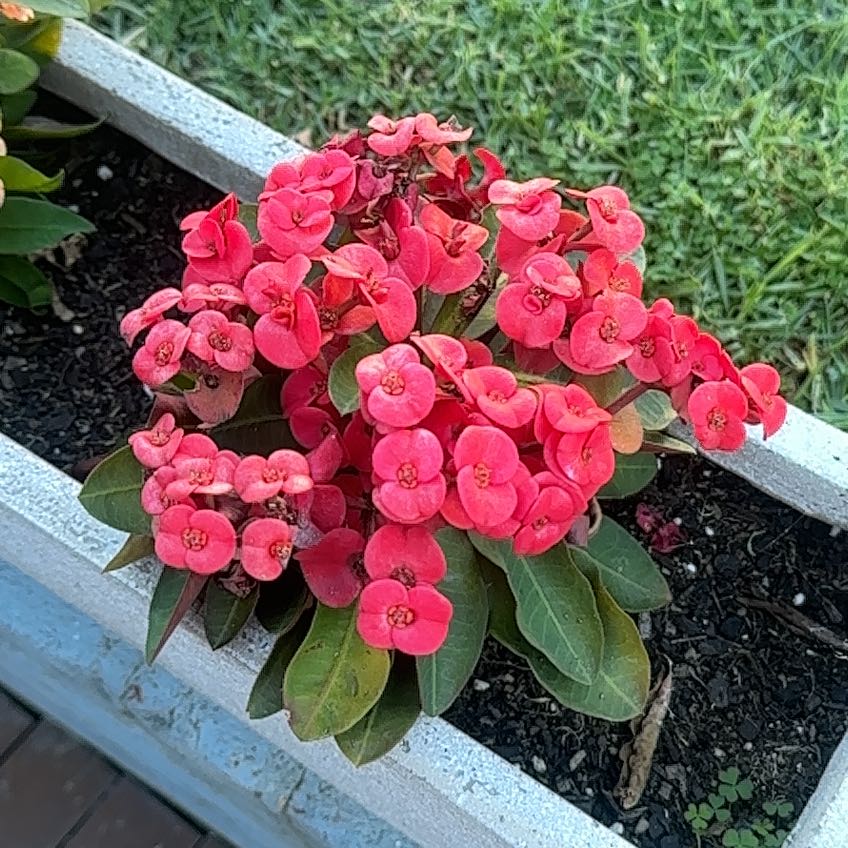
Crown of Thorns

How to Fertilize Crown of Thorns

Euphorbia milii
Reviewed by Kiersten Rankel M.S.
Quick Answer
Use a balanced liquid fertilizer (10-10-10) diluted to half strength every two weeks during spring and summer. Crown of Thorns is a light feeder, so less is more. Stop fertilizing in winter.

When Should I Start Feeding My Crown of Thorns?

Crown of Thorns responds to increasing day length in spring, so begin feeding when you see new leaf and bud growth picking up in your area.

US feeding regions map
Pacific Mar–Oct
Mountain May–Aug
Midwest Apr–Sep
Northeast May–Sep
Southeast Mar–Oct
Stay on top of plant care
Get seasonal reminders for watering and fertilizing — personalized for your plants.
Try Greg Free

How Often Should I Fertilize My Crown of Thorns?

Feed every two weeks during the active growing season, roughly April through September. Crown of Thorns has a moderate growth rate and blooms almost nonstop, so regular feeding keeps the flowers coming.

Taper to once a month in early fall, then stop entirely for winter. Even though this plant may still produce a few flowers in winter, it doesn't need fertilizer when light levels drop.

Watch for signs of overfeeding: if the stems stretch out with long gaps between leaves, you're pushing too hard. Cut back to monthly and reduce the dilution.

Feeding Calendar
Spring & Summer
Half-strength balanced liquid every 2 weeks
Early Fall
Half-strength monthly, then taper off
Late Fall & Winter
No feeding

What Is the Best Fertilizer for Crown of Thorns?

A balanced liquid fertilizer with an even NPK ratio like 10-10-10 works well for Crown of Thorns. This plant blooms continuously when happy, so it benefits from steady, light nutrition rather than heavy doses.

Dilute to half the label rate every time. Crown of Thorns is a succulent from Madagascar that evolved in poor soils. Full-strength fertilizer causes salt burn and leggy growth.

If your plant isn't blooming well, try switching to a formula with slightly higher phosphorus, like 10-30-20, for one or two feedings. Phosphorus encourages flower production.

Synthetic
Low-nitrogen succulent formula that supports blooming. Use 7 drops per quart every two weeks during the growing season.
High-phosphorus formula to encourage heavier flowering. Use at quarter strength for a boost when blooms slow down.
Organic
Gentle organic liquid with higher phosphorus and potassium to support blooms. Feed monthly during the growing season.
Top-dress with a thin layer once in spring. Provides gentle, slow-release nutrition without any risk of salt burn.

How Do I Fertilize My Crown of Thorns?

1
Water your plant first
Soak the soil and let it drain before fertilizing. Crown of Thorns has fleshy roots that burn easily when dry soil meets concentrated fertilizer.
2
Dilute to half strength
Mix your balanced liquid fertilizer at half the recommended dose. For a 10-10-10 concentrate, that's typically 1/8 teaspoon per gallon.
3
Apply to the soil only
Pour the solution directly onto the soil. Keep it off the stems and leaves. The milky sap can react with fertilizer residue and cause irritation if you handle the plant later.
4
Let excess drain away
Empty the saucer after 15 minutes. Like most succulents, Crown of Thorns is very sensitive to standing water.
5
Wear gloves when handling
Crown of Thorns produces irritating latex sap, and the thorns are sharp. Always wear gloves when working around this plant, especially during fertilizing and watering.

Got More Questions?

Why did my Crown of Thorns stop blooming?
The most common cause is not enough light, not lack of fertilizer. Make sure it gets at least 4 hours of direct sun. If light is good, try one feeding with a higher-phosphorus formula.
What happens if I over-fertilize my Crown of Thorns?
You'll see leggy, stretched-out growth with fewer flowers. In severe cases, leaf tips turn brown and roots get damaged. Flush the soil with plain water and skip feeding for six weeks.
Can I use coffee grounds on Crown of Thorns?
No. Coffee grounds are acidic and retain moisture, both of which this drought-loving succulent dislikes. The added moisture also invites root rot.
Is the sap dangerous when I'm fertilizing?
The milky latex sap is a skin and eye irritant. Always wear gloves, and wash your hands if you touch the plant. Keep it away from children and pets during feeding.
Should I fertilize Crown of Thorns in winter?
No. Even if it's still producing a few blooms, the plant's growth slows significantly in winter. Fertilizer applied now just builds up as salts and stresses the roots.
Stay on top of plant care
Get seasonal reminders for watering and fertilizing — personalized for your plants.
Try Greg Free

About This Article

Kiersten Rankel M.S.
Botanical Data Lead at Greg · Plant Scientist
About the Author
Kiersten Rankel holds an M.S. in Ecology & Evolutionary Biology from Tulane University. A certified Louisiana Master Naturalist, she has over a decade of experience in science communication, with research spanning corals, cypress trees, marsh grasses, and more. At Greg, she curates species data and verifies care recommendations against botanical research.
See Kiersten Rankel's full background on LinkedIn.
Editorial Process
Fertilizer recommendations verified against Euphorbia milii growth data from Greg's botanical database, cross-referenced with USDA hardiness zone data and published horticultural research.
6,534+ Greg users growing this plant
USDA hardiness zones 9a–11b