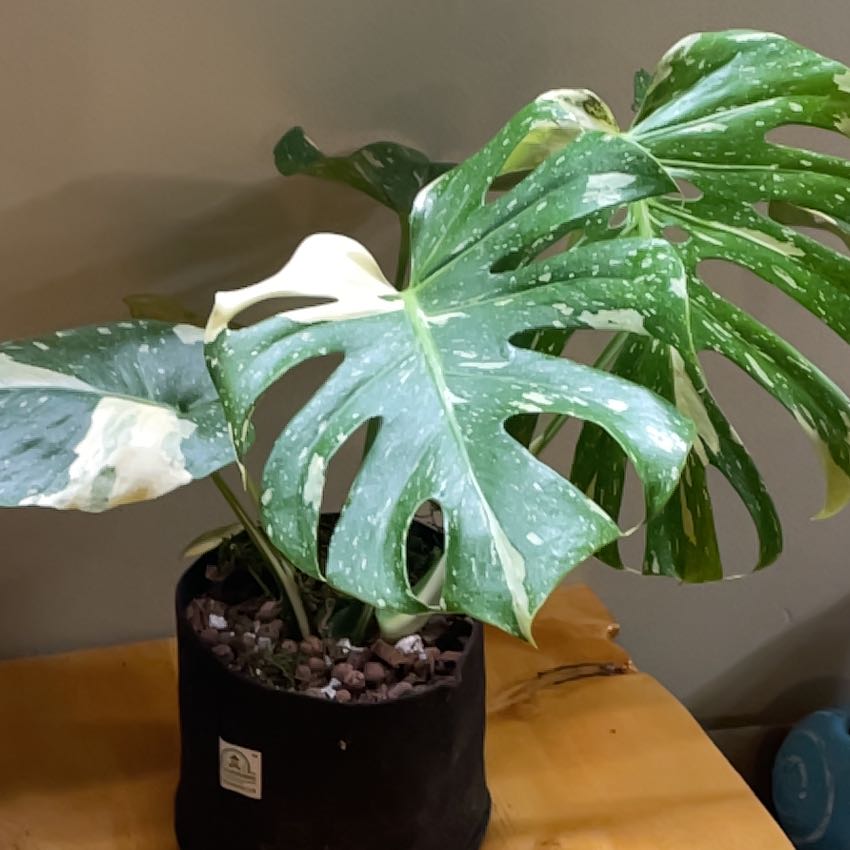
Thai Constellation Monstera

How to Fertilize Thai Constellation Monstera

Monstera deliciosa 'Thai Constellation'
Reviewed by Kiersten Rankel M.S.
Quick Answer
Use a liquid fertilizer with a higher nitrogen ratio like 3-1-2 or 9-3-6, diluted to half strength. Feed every two weeks during spring and summer. Reduce to monthly in early fall and stop in winter.

When Should I Start Feeding My Thai Constellation Monstera?

Thai Constellation Monstera is a tropical indoor plant (zones 10a–12b) that follows seasonal light changes, so feeding should ramp up as daylight increases in spring.

US feeding regions map
Pacific Mar–Oct
Mountain May–Sep
Midwest Apr–Sep
Northeast Apr–Sep
Southeast Mar–Oct
Stay on top of plant care
Get seasonal reminders for watering and fertilizing — personalized for your plants.
Try Greg Free

How Often Should I Fertilize My Thai Constellation Monstera?

Feed every two weeks during the active growing season from spring through summer. This plant is a moderate grower that puts out large, energy-intensive leaves, so it benefits from consistent nutrition.

Cut back to once a month in early fall as light levels drop. Stop entirely from November through February. Even with grow lights, the plant's metabolism slows in winter and fertilizer just accumulates as unused salts.

Watch for dark green, healthy new leaves as a sign feeding is on track. Brown leaf tips or edges can mean too much fertilizer. Smaller-than-expected new leaves with good fenestration usually mean the plant is healthy but could use a bit more light, not food.

Feeding Calendar
Spring & Summer
Half-strength liquid fertilizer every 2 weeks
Early Fall
Half-strength liquid fertilizer once a month
Late Fall & Winter
No feeding

What Is the Best Fertilizer for Thai Constellation Monstera?

A liquid fertilizer with a 3-1-2 NPK ratio (like 9-3-6) is ideal for Thai Constellation Monstera. The higher nitrogen supports the large leaf growth this plant is known for, while the lower phosphorus and potassium keep overall nutrition balanced.

Dilute to half the label's recommended strength. Thai Constellation grows slower than a standard Monstera deliciosa because its variegated leaves produce less chlorophyll, so full-strength doses can overwhelm the roots.

Liquid fertilizer is the best choice because it lets you control the concentration precisely. Slow-release granules work too, but use half the recommended amount since you can't adjust once they're in the soil.

Synthetic
Complete liquid formula with all 16 essential nutrients in a 3-1-2 ratio. Mix 1/8 tsp per gallon for half-strength feeding.
Reliable water-soluble powder. Use half the recommended rate for consistent biweekly feeding during the growing season.
Organic
All-in-one organic option with mycorrhizae that supports root health. One half-scoop per gallon for regular feeding.
High-nitrogen organic option that's great for foliage plants. Dilute to half strength. Has a strong smell, so apply near an open window.
Gentle, slow-release soil amendment. Top-dress with a thin layer every couple of months for steady background nutrition.

How Do I Fertilize My Thai Constellation Monstera?

1
Water your plant thoroughly first
Soak the soil with plain water and let it drain before applying fertilizer. Monstera roots are thick but still susceptible to chemical burn on dry soil.
2
Dilute to half strength
Mix your liquid fertilizer at half the label rate. For a 9-3-6 concentrate like Dyna-Gro, that's about 1/8 teaspoon per gallon.
3
Pour evenly over the soil surface
Apply the solution slowly across the entire soil surface so roots get even coverage. Avoid pouring it directly against the stem or aerial roots.
4
Let excess drain completely
Allow all runoff to exit the drainage hole and discard it. Standing in fertilizer water invites root rot, which variegated Monsteras are slower to recover from.
5
Wipe any splashes off the leaves
If fertilizer solution lands on the leaves, wipe it off with a damp cloth. The white variegated sections are especially prone to showing water spots and residue marks.
6
Flush the soil every 2-3 months
Run plain water through the pot for several minutes to dissolve accumulated salts. This prevents root burn and keeps the soil environment healthy between feedings.

Got More Questions?

Can I use banana peels to fertilize my Thai Constellation?
Banana peels don't deliver meaningful nutrients to potted plants. They decompose too slowly in a pot and can attract fungus gnats. Stick with a proper liquid fertilizer for reliable results.
What happens if I over-fertilize my Thai Constellation Monstera?
The leaf tips and edges turn brown and crispy, and you may see white salt crust on the soil surface. Flush the soil thoroughly with plain water and skip feeding for 4-6 weeks to let the plant recover.
Does Thai Constellation need more fertilizer than regular Monstera?
Actually less. The variegated leaves have less chlorophyll, so the plant grows slower and uses nutrients at a lower rate. Feeding at the same rate as a standard Monstera can cause salt buildup and root damage.
Should I fertilize my Thai Constellation when it's putting out a new leaf?
Yes, that's a great time to feed. New leaf production is the most energy-intensive phase. Just stick to your regular half-strength schedule rather than giving an extra dose.
Can I use slow-release fertilizer pellets instead of liquid?
You can, but use half the recommended amount. The downside is you lose control over the concentration once pellets are in the soil. Liquid lets you adjust dose and frequency as the plant's needs change seasonally.
Stay on top of plant care
Get seasonal reminders for watering and fertilizing — personalized for your plants.
Try Greg Free

About This Article

Kiersten Rankel M.S.
Botanical Data Lead at Greg · Plant Scientist
About the Author
Kiersten Rankel holds an M.S. in Ecology & Evolutionary Biology from Tulane University. A certified Louisiana Master Naturalist, she has over a decade of experience in science communication, with research spanning corals, cypress trees, marsh grasses, and more. At Greg, she curates species data and verifies care recommendations against botanical research.
See Kiersten Rankel's full background on LinkedIn.
Editorial Process
Fertilizer recommendations verified against Monstera deliciosa 'Thai Constellation' growth data from Greg's botanical database, cross-referenced with USDA hardiness zone data and published horticultural research.
5,344+ Greg users growing this plant
USDA hardiness zones 10a–12b