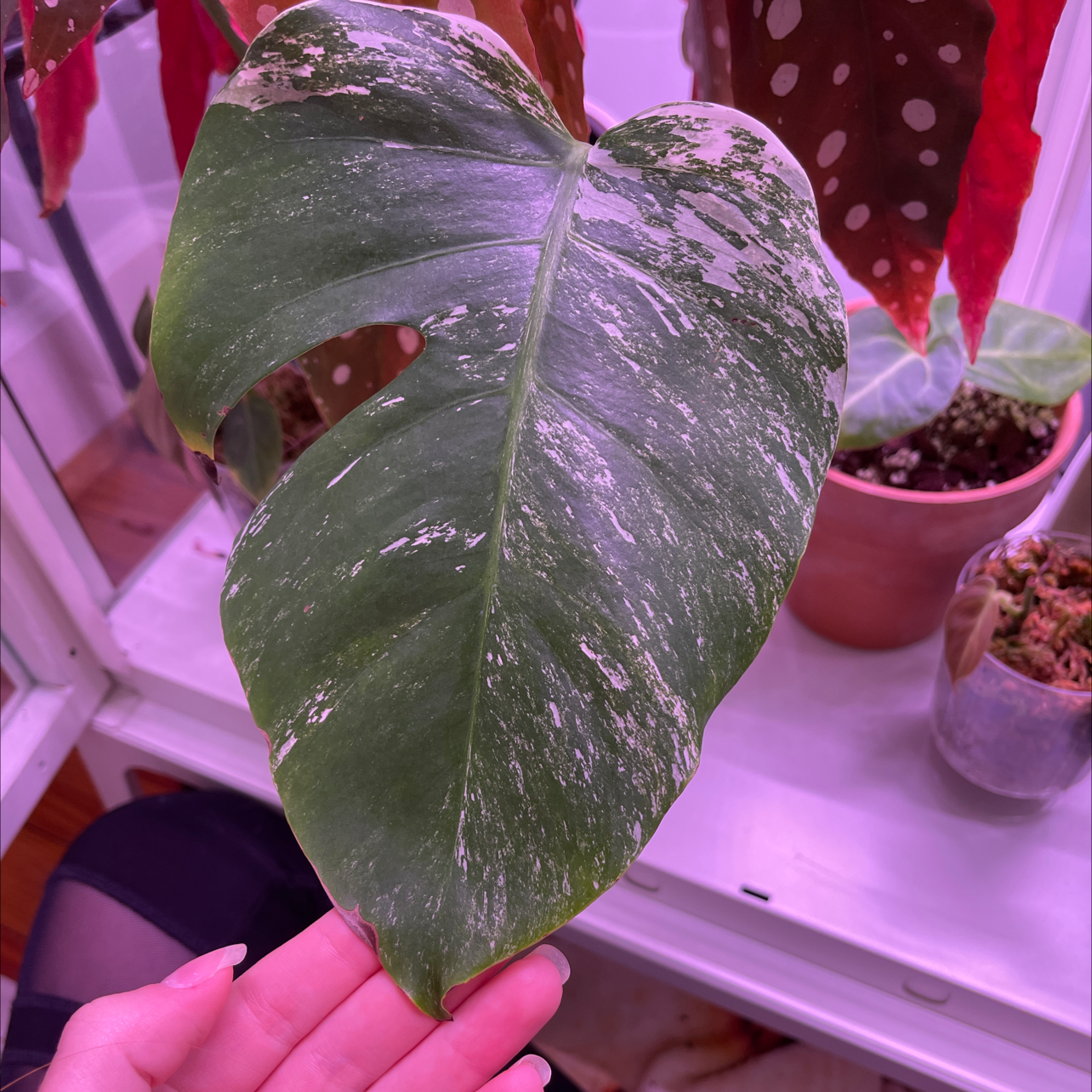
Monstera 'Albo'

How to Fertilize Monstera 'Albo'

Monstera deliciosa 'Albo'
Reviewed by Kiersten Rankel M.S.
Quick Answer
Use a nitrogen-rich liquid fertilizer (3-1-2 ratio) at half strength every 2 to 4 weeks in spring and summer. Variegated leaves mean slower growth, so feed lighter than a standard Monstera.

When Should I Start Feeding My Monstera Albo?

Begin feeding in early spring when you see a new leaf or root emerging from the growth point, which signals the plant is actively using nutrients again.

US feeding regions map
Pacific Mar–Oct
Mountain Apr–Sep
Midwest Apr–Sep
Northeast Apr–Sep
Southeast Mar–Oct
Stay on top of plant care
Get seasonal reminders for watering and fertilizing — personalized for your plants.
Try Greg Free

How Often Should I Fertilize My Monstera Albo?

Every 2 to 4 weeks during spring and summer is a good rhythm. Because variegated plants grow slower than their all-green counterparts, leaning toward every 3 to 4 weeks is often safer than every 2.

In early fall, reduce to once a month at quarter strength. Stop feeding entirely from late fall through winter. Even under grow lights, the reduced daylight hours slow growth enough that fertilizer will accumulate rather than get used.

Brown leaf edges on the white sections are an early warning sign of fertilizer burn. If you see this, flush the soil and extend the interval between feedings.

Feeding Calendar
Spring & Summer
Half-strength liquid fertilizer every 2-4 weeks
Early Fall
Quarter-strength monthly, tapering off
Late Fall & Winter
No feeding

What Is the Best Fertilizer for Monstera Albo?

A liquid fertilizer with a 3-1-2 NPK ratio (such as 9-3-6) supports the foliage growth that Monstera Albo needs. The extra nitrogen helps the green portions of the leaves work harder to compensate for the white variegated sections, which cannot photosynthesize.

Always dilute to half the label strength. Monstera Albo grows slower than a fully green Monstera deliciosa, so it processes nutrients at a slower rate and is more sensitive to salt buildup.

Liquid fertilizers are the safest option because you can adjust the dose easily. Avoid slow-release granules, as they can over-deliver nutrients to a plant that is not using them as quickly as you might expect.

Synthetic
Complete liquid formula with all 16 essential nutrients. Mix 1/8 teaspoon per gallon for variegated Monsteras.
Affordable liquid concentrate. Use 3 to 4 drops per quart at half rate for a gentle, balanced feed.
Organic
All-in-one organic option with mycorrhizae. Very gentle and forgiving for expensive variegated plants.
Classic organic nitrogen source. Dilute well and apply outdoors or in a well-ventilated area due to the strong smell.
The gentlest option. Top-dress with a thin layer every couple of months for slow, steady nutrition with zero burn risk.

How Do I Fertilize My Monstera Albo?

1
Water your plant first
Soak the soil thoroughly with plain water before fertilizing. Monstera Albo roots are sensitive, and dry soil concentrates fertilizer salts around them.
2
Dilute to half strength
Mix your liquid fertilizer at half the label rate. Variegated plants process nutrients more slowly than their all-green relatives, so a lighter dose is safer.
3
Apply to the soil only
Pour the diluted solution slowly around the base of the plant. Keep fertilizer off the leaves entirely. The white variegated sections are especially vulnerable to chemical spotting.
4
Drain excess water
Let the pot drain completely and empty the saucer after 30 minutes. Standing water with dissolved fertilizer can cause root rot, which is devastating for a slow-growing plant.
5
Watch the white leaf sections
The variegated portions show fertilizer stress before the green ones do. If white leaf edges start turning brown or crispy, you are likely feeding too often or too strong. Pull back immediately.

Got More Questions?

Can I use banana peels to fertilize my Monstera Albo?
Banana peels break down very slowly in potting soil and attract fungus gnats. They do not deliver meaningful nutrients to a potted plant. A proper liquid fertilizer is a much better investment for an expensive variegated Monstera.
What happens if I over-fertilize my Monstera Albo?
The white leaf sections will develop brown, crispy edges first since they are more sensitive than the green areas. In severe cases, roots can burn and the plant may drop leaves. Flush the soil with plain water and skip feeding for at least a month.
Does Monstera Albo need more fertilizer than a regular Monstera?
No, it actually needs less. The white portions of the leaves cannot photosynthesize, so the plant grows slower and processes nutrients at a lower rate. Feed at half the frequency and strength you would use for an all-green Monstera deliciosa.
Will fertilizer affect the amount of variegation?
Fertilizer does not control variegation, which is genetic. However, a well-fed plant produces larger, healthier leaves overall. Light levels have much more influence on how much white versus green each new leaf develops.
Should I fertilize a Monstera Albo cutting that is rooting?
Wait until the cutting has established roots at least 2 to 3 inches long and is pushing a new leaf. Fertilizer cannot be absorbed without a functioning root system and will only contaminate the water or soil.
Stay on top of plant care
Get seasonal reminders for watering and fertilizing — personalized for your plants.
Try Greg Free

About This Article

Kiersten Rankel M.S.
Botanical Data Lead at Greg · Plant Scientist
About the Author
Kiersten Rankel holds an M.S. in Ecology & Evolutionary Biology from Tulane University. A certified Louisiana Master Naturalist, she has over a decade of experience in science communication, with research spanning corals, cypress trees, marsh grasses, and more. At Greg, she curates species data and verifies care recommendations against botanical research.
See Kiersten Rankel's full background on LinkedIn.
Editorial Process
Fertilizer recommendations verified against Monstera deliciosa 'Albo' growth data from Greg's botanical database, cross-referenced with USDA hardiness zone data and published horticultural research.
8,387+ Greg users growing this plant
USDA hardiness zones 10a–12b