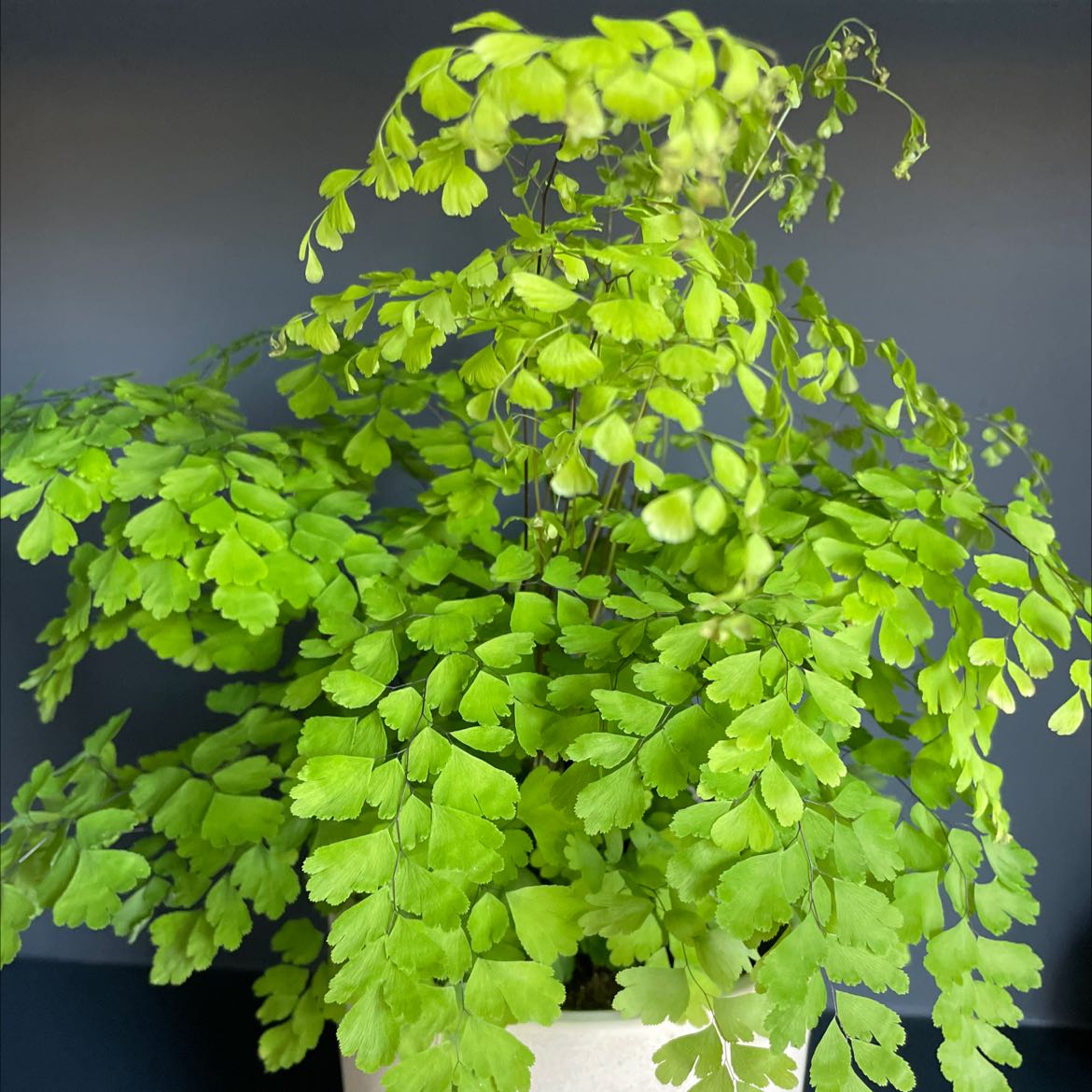
Maidenhair Fern

How to Fertilize Maidenhair Fern

Adiantum capillus-veneris
Reviewed by Kiersten Rankel M.S.
Quick Answer
Feed your Maidenhair Fern with a balanced liquid fertilizer (10-10-10 or 20-20-20) diluted to one-quarter strength. Apply monthly from spring through early fall. Stop feeding in winter when growth slows. Maidenhair Ferns are salt-sensitive, so less is always safer than more.

When Should I Start Feeding My Maidenhair Fern?

Maidenhair Ferns respond to lengthening daylight in spring, and feeding should follow the same seasonal rhythm even for indoor plants.

US feeding regions map
Pacific Mar–Oct
Mountain May–Sep
Midwest Apr–Sep
Northeast Apr–Sep
Southeast Mar–Oct
Stay on top of plant care
Get seasonal reminders for watering and fertilizing — personalized for your plants.
Try Greg Free

How Often Should I Fertilize My Maidenhair Fern?

Feed once a month during the growing season, from spring through early fall. That is roughly five to six feedings per year.

In late fall, taper to every six weeks, then stop completely in winter. Even though Maidenhair Ferns are evergreen indoors, their growth slows significantly when light levels drop.

Watch for browning leaf edges or crispy frond tips. These are often signs of fertilizer salt buildup rather than under-feeding. If you see them, flush the soil with plain water and skip the next scheduled feeding.

Feeding Calendar
Spring & Summer
Quarter-strength balanced liquid monthly
Early Fall
Quarter-strength every 6 weeks, tapering off
Late Fall & Winter
No feeding

What Is the Best Fertilizer for Maidenhair Fern?

A balanced liquid fertilizer with equal parts nitrogen, phosphorus, and potassium works well for Maidenhair Ferns. Look for a 10-10-10 or 20-20-20 ratio. These ferns produce delicate fronds rather than flowers, so they do not need a high-phosphorus blend.

Dilute to one-quarter the label rate. Maidenhair Ferns have extremely fine, shallow roots that are sensitive to salt buildup. A full-strength dose can scorch the fronds within days.

Liquid fertilizer is the best delivery method because it distributes evenly through the moist soil these ferns require. Avoid granular or slow-release products that can create concentrated pockets of nutrients near the roots.

Synthetic
Water-soluble balanced formula. Use 1/8 teaspoon per gallon for Maidenhair Ferns, which is one-quarter the normal rate.
Affordable liquid concentrate. Use 2-3 drops per quart instead of the recommended 7 drops to keep the dose gentle.
Organic
Gentle all-in-one organic formula with mycorrhizae that support the fern's shallow root system. Half a scoop per gallon.
Mix a thin layer into the top inch of soil every couple of months. Releases nutrients slowly and improves soil structure without any burn risk.
Mild organic liquid with trace minerals. Dilute to half the label rate for ferns. Has a noticeable smell that fades within a day.

How Do I Fertilize My Maidenhair Fern?

1
Water thoroughly first
Maidenhair Ferns should always be in moist soil. Water until it drains from the bottom, then wait about 15 minutes before fertilizing. Wet roots absorb nutrients more safely.
2
Dilute to quarter strength
Mix your balanced liquid fertilizer at one-quarter the label rate. For a 20-20-20 concentrate, that is typically about 1/8 teaspoon per gallon of water.
3
Pour evenly over the soil
Apply the diluted solution across the entire soil surface so it reaches all of the shallow root system. Avoid pouring directly onto the fronds, which can cause spotting.
4
Let excess drain away
Allow the pot to drain fully. Never let a Maidenhair Fern sit in a saucer of fertilizer water, as salt accumulation at the bottom will damage roots over time.
5
Flush the soil every few months
Every two to three months, water with plain water until it runs freely from the drainage holes. This washes away any salt buildup before it reaches harmful levels.

Got More Questions?

Can I use coffee grounds on my Maidenhair Fern?
In small amounts, used coffee grounds can work as a light top-dressing since Maidenhair Ferns tolerate slightly acidic soil. However, too much retains excess moisture and can attract fungus gnats. A proper liquid fertilizer is more reliable.
What happens if I over-fertilize my Maidenhair Fern?
The frond tips will turn brown and crispy, and entire fronds may yellow and drop. Flush the soil with plain water several times and skip feeding for at least two months. Maidenhair Ferns are among the most salt-sensitive houseplants.
Why do my Maidenhair Fern fronds turn brown even with fertilizer?
Browning is more often caused by low humidity, dry soil, or too much direct sun than by nutrient deficiency. Make sure humidity stays above 50% and the soil never dries out completely before blaming a lack of fertilizer.
Should I fertilize a Maidenhair Fern that just lost all its fronds?
No. If your fern has died back to the soil line, keep the soil moist and wait for new fiddleheads to appear. Only resume feeding once you see at least two or three new fronds unfurling.
Can I use banana peels as fertilizer for my fern?
Banana peels do not break down fast enough in a pot to deliver useful nutrients and can attract pests. A dilute liquid fertilizer provides the balanced nutrition Maidenhair Ferns actually need.
Stay on top of plant care
Get seasonal reminders for watering and fertilizing — personalized for your plants.
Try Greg Free

About This Article

Kiersten Rankel M.S.
Botanical Data Lead at Greg · Plant Scientist
About the Author
Kiersten Rankel holds an M.S. in Ecology & Evolutionary Biology from Tulane University. A certified Louisiana Master Naturalist, she has over a decade of experience in science communication, with research spanning corals, cypress trees, marsh grasses, and more. At Greg, she curates species data and verifies care recommendations against botanical research.
See Kiersten Rankel's full background on LinkedIn.
Editorial Process
Fertilizer recommendations verified against Adiantum capillus-veneris growth data from Greg's botanical database, cross-referenced with USDA hardiness zone data and published horticultural research.
4,469+ Greg users growing this plant
USDA hardiness zones 9a–11b