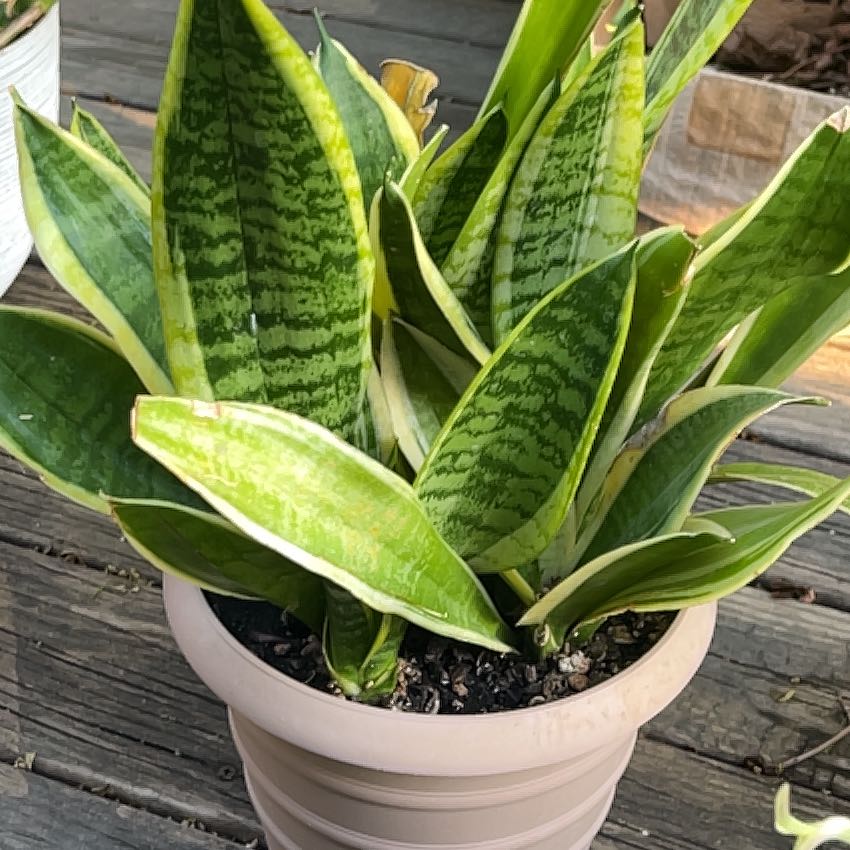
Snake Plant

How to Prune Snake Plant

Dracaena trifasciata
Reviewed by Kiersten Rankel M.S.
Quick Answer
Prune your Snake Plant in spring or early summer when it's actively growing. Focus on removing yellow, brown-tipped, or damaged leaves by cutting them off at the soil line. Never remove more than a third of the leaves at once, as this plant grows slowly and needs its foliage to thrive.

When is the best time to prune?

Because Snake Plants are adaptable to a wide range of conditions across zones 9–11, your pruning window is flexible, but spring is the best time to tidy up.

US pruning regions map
Pacific
Feb–Apr
Mountain
Apr–Jun
Midwest
Mar–May
Northeast
Apr–Jun
Southeast
Feb–Apr
Stay on top of plant care
Get seasonal reminders for watering and fertilizing — personalized for your plants.
Try Greg Free

Why Should I Prune My Snake Plant?

Snake Plants are slow growers that don't need much pruning, but a little cleanup goes a long way. Removing old, damaged, or discolored leaves keeps the plant looking sharp and prevents any rot from spreading to healthy tissue.

The most common reason to prune is brown leaf tips, which appear after inconsistent watering or low humidity. You can snip just the brown portion at a slight angle so the remaining tip looks natural, or remove the whole leaf from the base if most of it is damaged.

To remove a whole leaf, cut it as close to the soil line as possible using clean, sharp scissors or pruners. Leaving a stub invites rot, so cut all the way down. There's no need to seal the cut on a Snake Plant.

Avoid pruning healthy green leaves just to shape the plant. Snake Plants look best when their natural upright form is preserved. Only remove what's visibly damaged, dying, or crowding the container.

Know Before You Cut

Difficulty Easy
Max removal 1/3 of leaves at a time
Growth pattern Clumping rosette
Tools Sharp scissors or hand pruners

What Should I Remove?

Remove yellow or mushy leaves at the soil line
Trim brown leaf tips at a slight angle
Pull away dead leaf sheaths from the base
Cut fully damaged leaves as close to soil as possible
Don't cut healthy green leaves to change the shape
Don't leave stubs at the base — they invite rot
Don't remove more than a third of the plant at once

How Do I Prune Step by Step?

1
Clean and sharpen your tools
Wipe scissors or pruner blades with rubbing alcohol before starting. Clean tools prevent bacteria from spreading between cuts.
2
Identify leaves to remove
Look for leaves that are yellow, brown, mushy at the base, or more than half damaged. Healthy leaves should be left alone.
3
Remove damaged leaves at the base
Grip the leaf near the soil and cut straight through at the soil line. Cut as close to the base as possible without disturbing the roots.
4
Trim brown tips if needed
For leaves that are mostly healthy but have brown tips, cut across the leaf at a slight angle just past the brown area. This keeps the tip looking natural.
5
Clear away debris
Remove any dead leaf material from the surface of the soil to discourage pests and keep the pot tidy.

Got More Questions?

Can I prune my Snake Plant in winter?
You can remove severely damaged or rotting leaves any time of year, but avoid major pruning in winter when the plant is growing slowly. Spring is the best time for a thorough cleanup.
What if I accidentally cut off too many leaves?
Snake Plants are forgiving. As long as some healthy leaves remain, the plant will recover. Move it to bright indirect light, ease up on watering, and let it grow back at its own pace.
Why do my Snake Plant's leaf tips keep turning brown?
Brown tips are usually caused by inconsistent watering, low humidity, or fluoride in tap water. Trimming the tips won't fix the cause, so check your watering habits and consider using filtered water.
Can I use the leaves I cut off to grow new plants?
Yes. Snake Plant leaves can be propagated by cutting them into sections about 3–4 inches long and rooting them in water or moist soil. Keep in mind that variegated varieties may lose their coloring this way.
Stay on top of plant care
Get seasonal reminders for watering and fertilizing — personalized for your plants.
Try Greg Free

About This Article

Kiersten Rankel M.S.
Botanical Data Lead at Greg · Plant Scientist
About the Author
Kiersten Rankel holds an M.S. in Ecology & Evolutionary Biology from Tulane University. A certified Louisiana Master Naturalist, she has over a decade of experience in science communication, with research spanning corals, cypress trees, marsh grasses, and more. At Greg, she curates species data and verifies care recommendations against botanical research.
See Kiersten Rankel's full background on LinkedIn.
Editorial Process
Pruning guidance verified against Dracaena trifasciata growth data from Greg's botanical database, cross-referenced with USDA hardiness zone data and published horticultural research.
124,850+ Greg users growing this plant
USDA hardiness zones 9a–11b
Grow plants with confidence