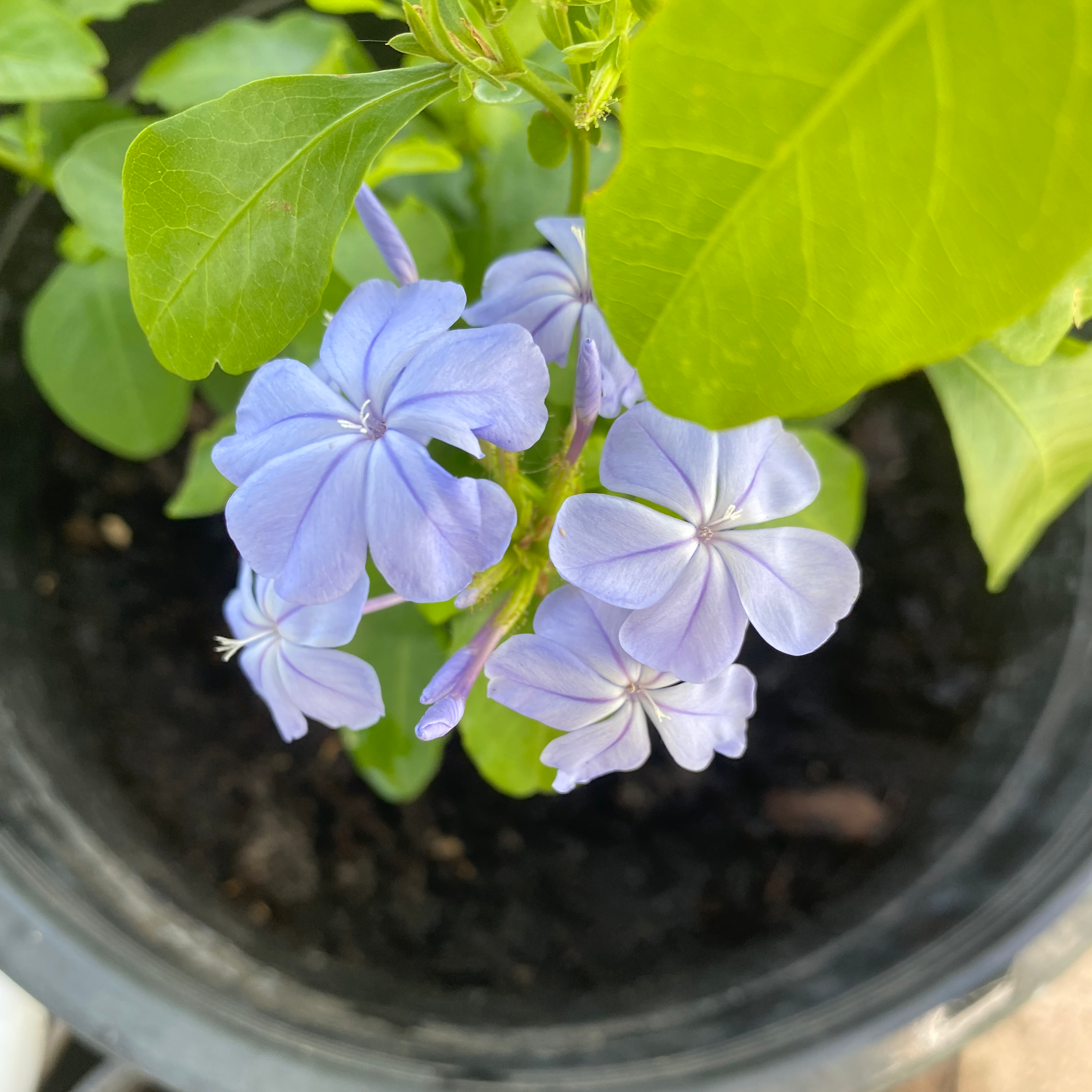
Blue Plumbago

How to Prune Blue Plumbago

Plumbago auriculata
Reviewed by Kiersten Rankel M.S.
Quick Answer
Prune blue plumbago in late winter or early spring before new growth starts. Cut the entire plant back by one-third to one-half to promote bushy growth and heavy flowering. Plumbago blooms on new wood, so harder pruning means more flowers. Deadhead spent blooms through summer to extend the display.

When is the best time to prune?

Blue plumbago flowers on current-season growth, so late winter pruning gives it a fresh start and maximizes the number of flowering stems for the upcoming season.

US pruning regions map
Pacific
Jan–Mar
Mountain
Apr–May
Midwest
Mar–Apr
Northeast
Mar–Apr
Southeast
Feb–Mar
Stay on top of plant care
Get seasonal reminders for watering and fertilizing — personalized for your plants.
Try Greg Free

Why Should I Prune My Blue Plumbago?

Blue plumbago is a vigorous grower that can get leggy and sprawling without regular pruning. It flowers on new growth, which means the more you prune, the more flowering stems you get. Left unpruned, it becomes a tangled mass with flowers only at the tips.

The main pruning happens in late winter or early spring before the plant breaks dormancy. Cut the whole plant back by one-third to one-half. You can even cut it to within a few inches of the ground if it's badly overgrown. Plumbago rebounds quickly and will be covered in sky-blue flowers by summer.

During the growing season, deadhead spent flower clusters regularly. This encourages continuous blooming instead of the plant putting energy into seed production. You can also do light tip pruning in midsummer to shape the plant and trigger a second flush of flowers.

Plumbago has sticky, glandular hairs on its flower calyxes that cling to clothing and skin. Wear gloves and clothes you don't mind getting sticky when pruning around the flower clusters.

Know Before You Cut

Difficulty Easy
Max removal Up to 1/2 of the plant
Growth pattern Sprawling shrub or scrambler
Tools Pruners and hedge shears

What Should I Remove?

Cut back by 1/3 to 1/2 in late winter
Deadhead spent flower clusters regularly
Remove dead or frost-damaged wood
Shape with light tip pruning in midsummer
Don't prune in fall (new growth may not harden)
Don't leave sticky flower debris on the plant
Don't skip annual pruning or it gets very leggy

How Do I Prune Step by Step?

1
Assess overall shape and size
Look at the plant's structure. Identify any dead, crossing, or overly long stems that need removal.
2
Cut the whole plant back by one-third to one-half
Use hedge shears or pruners to reduce the overall size evenly. Cut to outward-facing buds where possible.
3
Remove dead and frost-damaged wood
Cut any brown, brittle stems back to live, green wood. Scratch the bark with a thumbnail to check if there's green underneath.
4
Shape and thin the interior
Remove a few of the oldest, woodiest stems at the base to open up the center. This improves air circulation and reduces disease.
5
Deadhead through the season
Pinch or cut spent flower clusters just below the faded blooms. New flower buds will form on the remaining stem within a few weeks.

Got More Questions?

Can I cut plumbago to the ground?
Yes. If the plant is badly overgrown or frost-damaged, cutting it to 4–6 inches above ground is fine. It will regrow vigorously in spring.
Why isn't my plumbago flowering much?
Usually it needs more sun or more pruning. Plumbago flowers on new wood, so without cutting it back annually, flowers only appear at the tips of old growth.
How do I keep plumbago from spreading everywhere?
Regular pruning keeps it in bounds. You can also root-prune by cutting around the base with a spade. It spreads by suckers, so removing these regularly helps.
Is plumbago's sticky coating on the flowers harmful?
It's not toxic but it's very sticky and annoying to get off clothing. The stickiness is a natural insect-trapping mechanism. Wear gloves when handling flowers.
Can I grow plumbago as a hedge?
Yes, with frequent pruning. Shear it 2–3 times during the growing season to maintain a hedge shape. It responds well to repeated clipping and keeps flowering.
Stay on top of plant care
Get seasonal reminders for watering and fertilizing — personalized for your plants.
Try Greg Free

About This Article

Kiersten Rankel M.S.
Botanical Data Lead at Greg · Plant Scientist
About the Author
Kiersten Rankel holds an M.S. in Ecology & Evolutionary Biology from Tulane University. A certified Louisiana Master Naturalist, she has over a decade of experience in science communication, with research spanning corals, cypress trees, marsh grasses, and more. At Greg, she curates species data and verifies care recommendations against botanical research.
See Kiersten Rankel's full background on LinkedIn.
Editorial Process
Pruning guidance verified against Plumbago auriculata growth data from Greg's botanical database, cross-referenced with USDA hardiness zone data and published horticultural research.
625+ Greg users growing this plant
USDA hardiness zones 8a–11b
Grow plants with confidence