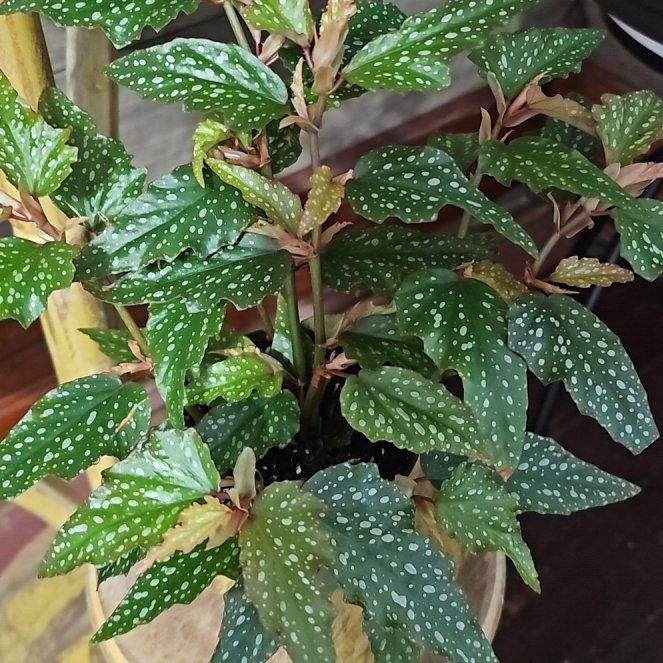
Angel Wing Begonia

How to Prune Angel Wing Begonia

Begonia coccinea
Reviewed by Kiersten Rankel M.S.
Quick Answer
Prune Angel Wing Begonia in early spring, just as new growth begins. Pinch or cut back leggy canes to promote bushy, branching growth and more flowers. You can remove up to one third of the plant at a time, and regular light pinching throughout the growing season keeps it full rather than tall and sparse.

When is the best time to prune?

Angel Wing Begonia blooms and grows most actively in spring and summer, so timing pruning to just before the growing season gets underway encourages the most vigorous response.

US pruning regions map
Pacific
Feb–Mar
Mountain
Apr–May
Midwest
Mar–Apr
Northeast
Mar–May
Southeast
Feb–Mar
Stay on top of plant care
Get seasonal reminders for watering and fertilizing — personalized for your plants.
Try Greg Free

Why Should I Prune My Angel Wing Begonia?

Angel Wing Begonias are vigorous growers that quickly become tall and leggy without regular pruning. Cutting back the canes encourages the plant to branch lower down and produce more of its distinctive coral or red flowers.

The best pruning approach is to cut a cane just above a leaf node, which is where a leaf meets the stem. The plant will put out two new shoots from that point. Do this on multiple canes throughout the plant to build a fuller shape from the bottom up.

For indoor plants that have become very tall and sparse, you can cut them back quite hard in spring, reducing canes to about 6–8 inches. This feels drastic but the plant bounces back quickly once temperatures warm and light levels increase.

Light pinching throughout summer also helps. Pinch off just the growing tip above a leaf to keep canes from getting too long between major pruning sessions.

Know Before You Cut

Difficulty Easy
Max removal 1/3 of the plant at a time
Growth pattern Upright, cane-forming
Tools Sharp scissors or hand pruners

What Should I Remove?

Cut canes just above a leaf node to encourage branching
Pinch growing tips throughout summer to prevent legginess
Remove dead or damaged canes at the base
Cut back hard in spring if the plant is overly leggy
Don't prune during or just before blooming — wait until after
Don't cut below all leaf nodes on a cane — leave at least one
Don't skip pruning — leggy canes produce fewer flowers

How Do I Prune Step by Step?

1
Prune just before active growth begins
Time your main pruning for late winter to early spring, just as you see new growth starting at nodes. This lets the plant direct energy into fresh, branching growth.
2
Identify leggy or overly long canes
Look for canes that are bare near the base with leaves only at the tips. These are the primary targets for cutback.
3
Cut canes just above a leaf node
Make a clean cut about a quarter inch above a healthy leaf or node. Two new shoots will emerge from this point, creating a bushier shape.
4
Pinch tips throughout the season
Every few weeks during summer, pinch or snip off the very tip of actively growing canes just above a leaf. This keeps the plant compact without a major pruning session.
5
Remove completely dead canes
Cut any cane that is brown, dry, and leafless all the way back to where it meets the main stem or soil level.

Got More Questions?

When is the best time to prune my Angel Wing Begonia?
Early spring, just as new growth emerges, is ideal for the main pruning session. Light pinching can happen anytime during the growing season.
Will my Angel Wing Begonia bloom less if I prune it?
Initially you may lose some flower buds, but a well-pruned, branchy plant will produce many more blooms overall than a tall, sparse one. Prune after a flush of blooms finishes for the least disruption.
Can I cut my Angel Wing Begonia all the way back?
You can cut canes back hard in spring, but always leave at least one node on each cane. As long as a few nodes remain, the plant will regrow. Remove more than a third at a time and recovery will be slower.
My begonia's canes are drooping — should I prune them?
Drooping can mean the cane is too heavy for the stem, or the plant needs water. If it's structural, stake the cane first. If the cane is also bare and leggy, cutting it back is the right move.
Stay on top of plant care
Get seasonal reminders for watering and fertilizing — personalized for your plants.
Try Greg Free

About This Article

Kiersten Rankel M.S.
Botanical Data Lead at Greg · Plant Scientist
About the Author
Kiersten Rankel holds an M.S. in Ecology & Evolutionary Biology from Tulane University. A certified Louisiana Master Naturalist, she has over a decade of experience in science communication, with research spanning corals, cypress trees, marsh grasses, and more. At Greg, she curates species data and verifies care recommendations against botanical research.
See Kiersten Rankel's full background on LinkedIn.
Editorial Process
Pruning guidance verified against Begonia coccinea growth data from Greg's botanical database, cross-referenced with USDA hardiness zone data and published horticultural research.
650+ Greg users growing this plant
USDA hardiness zones 10a–11b
Grow plants with confidence