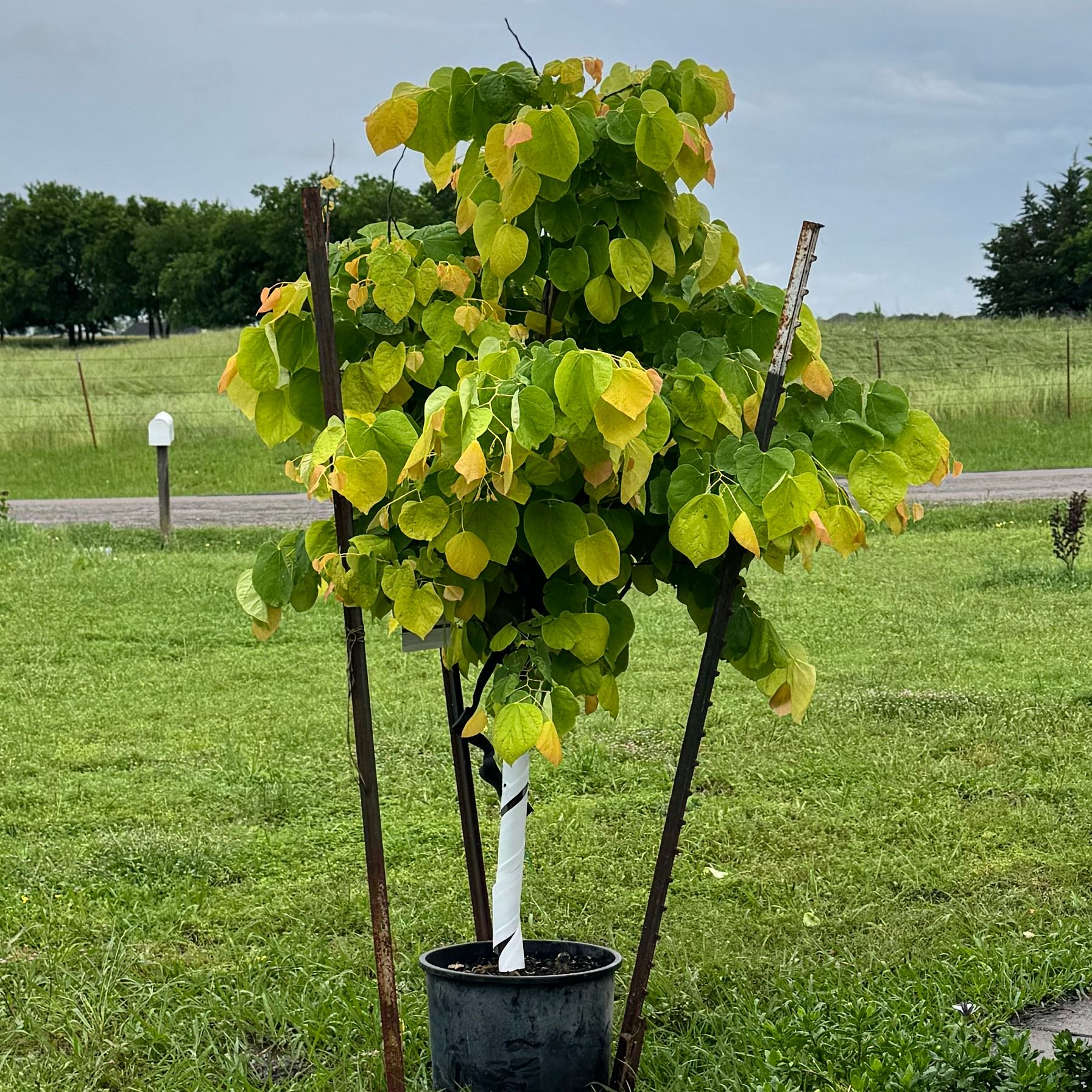
How to Grow a Rising Sun Redbud
Plant Rising Sun Redbud in full sun to part shade, in well-drained loamy soil, and give the tree 15 to 20 feet of clear space at maturity. The tree reaches 8 to 12 feet tall, blooms pink in early spring, then leafs out in a shifting display of peach, gold, and lime that holds through summer.

Where to plant
Rising Sun Redbud is a small deciduous flowering tree for USDA zones 5 to 9. The tree reaches 8 to 12 feet tall and roughly as wide in 10 to 12 years, making it a strong front yard feature tree, patio tree, or focal point at the corner of a mixed border.
Sun
Full sun to part shade. Full sun produces the most intense leaf color, especially the peach and orange new growth. Light afternoon shade is welcome in zone 8 and 9 sites where summer afternoon sun can scorch the colorful young foliage. Deeper shade fades the leaf color to a dull green-yellow.
Drainage
Rising Sun Redbud needs well-drained soil. The roots rot in soggy spots and the tree declines within a few seasons. Dig a one-foot test hole and fill with water. If it drains within a few hours, the spot works. If water sits overnight, build a raised mound 8 to 12 inches above grade.
Soil
Average loamy garden soil suits the tree. Mildly acidic to slightly alkaline conditions are both fine. Heavy clay benefits from a generous compost amendment and a raised mound. Very sandy soil benefits from extra compost to hold moisture during establishment.
Space
Give the tree 15 to 20 feet of clear space in every direction. Plant 6 to 10 feet away from a house wall to allow the canopy to develop a balanced shape and to avoid roof and gutter conflicts. The tree casts a light dappled shade that pairs well with shade-tolerant perennials underneath.
How to plant
Plant container-grown or balled-and-burlapped trees in early spring after the ground thaws, or in early fall at least six weeks before the first hard frost. Cool weather supports root establishment without summer heat stress.
-
1Dig a wide shallow hole Make the hole 2 to 3 times as wide as the root ball but no deeper. Wide shallow holes encourage root growth out into the surrounding soil rather than down into a wet pocket.
-
2Loosen the root ball If roots are circling the nursery pot, gently tease them apart or score the outside with a sharp knife. For balled-and-burlapped trees, leave the burlap and wire basket in place while setting the tree, then cut and remove the top third once the tree is positioned.
-
3Set the tree slightly high The top of the root ball should sit about 1 inch above the surrounding soil. The tree settles as the soil compacts, and a buried root flare leads to slow decline over years.
-
4Backfill with native soil and compost Mix a few handfuls of compost into the dug-out soil and refill the hole, firming gently as you go. Avoid pure compost or fancy planting mixes in the hole, since roots get lazy in rich pockets and never spread out into the surrounding yard.
-
5Water deeply Soak the entire root zone slowly with a hose at a trickle until the water settles. A first deep watering at planting is the most important watering of the tree's first year.
-
6Mulch 2 to 3 inches deep Apply shredded bark or wood chip mulch in a 3-foot ring around the trunk, kept several inches back from the trunk itself. Avoid volcano-shaped mulch piles, which suffocate the trunk and rot the bark over time.
Watering and feeding
Watering
Water deeply once a week through the first two growing seasons to establish the root system, soaking the root zone slowly rather than splashing the trunk. Drip lines or a slow trickle from a hose at the base work best. A young tree needs roughly 5 to 10 gallons per watering depending on size.
Once established, Rising Sun Redbud is moderately drought-tolerant and gets by on rainfall in most years. A deep weekly soak during extended summer dry spells keeps the foliage colorful and prevents leaf scorch. The colorful young foliage is especially sensitive to drought stress and shows browning at the edges first.
Feeding
Feed once in early spring as new growth starts, using a balanced slow-release fertilizer or a one-inch top dressing of compost around the dripline. Avoid heavy nitrogen, which produces weak leafy growth and reduces flowering.
An established tree generally needs little or no fertilizer beyond what nearby lawn feeding provides. Stop all feeding by midsummer so new growth hardens off before winter.
Pruning
Rising Sun Redbud needs only light pruning, mostly to remove dead branches and shape the developing canopy in the first few years. The tree's natural form is graceful and lightly arching, and over-pruning ruins the silhouette. Pruning timing matters because the tree blooms on old wood.
When to prune
Prune right after the spring bloom fades, before the leaves fully emerge. Pruning during winter dormancy is also acceptable but sacrifices some bloom buds for the coming spring. Avoid pruning in late summer or fall, since cuts heal slowly going into winter.
What to cut
Remove dead, broken, or crossing branches at their base or back to a healthy outward-facing bud. Thin a few crowded interior branches to open up the canopy and improve airflow. Keep the natural arching form rather than shearing into a ball.
Train young trees by selecting 3 to 5 well-spaced main branches in the first few years and removing weaker competing leaders. A single dominant trunk produces the most graceful mature form.
Suckers and water sprouts
Snip suckers from the base of the trunk and remove vertical water sprouts from the upper limbs as they appear through the growing season. Both grow vigorously, look out of place against the arching natural form, and pull energy away from the rest of the canopy.
Blooming and color
Rising Sun Redbud delivers two distinct color seasons. The first is the early spring bloom of pink-purple flowers on bare branches before leaves emerge. The second is the shifting summer leaf color, where new growth emerges peach-apricot, transitions to gold, and matures to a lime-green that holds through summer.
Spring bloom
Flower buds open in early spring, usually March in the South and April in the North, and last 2 to 3 weeks. The flowers form in dense clusters directly on the bare branches and even on the older trunk, a feature called cauliflory that is one of the tree's most distinctive traits.
Bees and early-season pollinators visit the flowers heavily, which makes the tree a strong choice for a pollinator-friendly yard.
Shifting summer foliage
Heart-shaped leaves emerge in late spring in a striking peach-apricot color, gradually shifting through gold and finally settling into a glowing lime-green by midsummer. New growth pushes constantly through the season, so the tree carries all three colors at once during the warmer months.
Leaf color is strongest in full sun. In part shade the leaves tend toward green more quickly and the peach phase is less pronounced. Plant in a spot where morning sun catches the leaves for the most striking effect.
Fall color
In autumn the lime-green leaves transition to a warm yellow-gold before dropping. The fall show is briefer than the summer color but adds to the tree's appeal as a year-round focal point.
Winter structure
After the leaves drop, the smooth dark bark and gently arching branch structure provide quiet winter interest. Mature trees develop slightly furrowed gray-brown bark with attractive texture.
Common problems and pests
Most Rising Sun Redbud problems show up as either stress-related leaf or branch issues or as the fungal canker disease that is the genus's main weakness. The tree is otherwise reliable when sited well.
Wilted shoots and dead branch tips
Often canker disease (botryosphaeria or verticillium wilt), which enters through wounds and dead wood. Prune affected branches several inches below the dead tissue back to healthy wood and disinfect pruners between cuts with rubbing alcohol. Keep the tree well-watered through summer and mulched to reduce drought stress, which makes canker worse.
Leaf scorch on the colored new growth
Brown crispy edges on the peach and gold new leaves, especially in hot afternoon sun and during dry stretches. Water deeply once a week during dry weather and mulch the root zone two to three inches deep. Light afternoon shade in zone 8 and 9 sites reduces scorch significantly.
Leaves fading to green
Most often caused by insufficient sun. Move container-grown young trees to a sunnier spot or accept the duller color in shaded sites. Some seasonal greening in late summer is normal as the leaves age toward their lime-green mature color, with fresh new growth carrying the peach phase.
Few or no flowers in spring
Either a late spring frost killed the buds, the tree is too young (most trees take 3 to 5 years to flower heavily), or the tree was pruned in summer or fall after this year's buds had already set. Mark the calendar to prune only right after bloom, and protect young trees from late frosts by covering on the coldest nights.
Aphids on new growth
Small green or black insects clustered on tender new shoots in spring. Knock them off with a strong spray of water. Heavy infestations respond to insecticidal soap. Ladybugs and lacewings eat aphids faster than any spray, so encourage them by avoiding broad-spectrum insecticides.
Caterpillars chewing leaves
Several caterpillars feed on redbud leaves, including the redbud leaffolder. Damage is mostly cosmetic and the tree tolerates moderate defoliation. Hand-pick visible caterpillars or spray Bt (Bacillus thuringiensis) for heavy outbreaks. Avoid broad-spectrum insecticides that kill the beneficial insects keeping pests in check.
Yellow leaves with green veins
Iron chlorosis on alkaline soils where iron is locked up in the soil chemistry. Apply a chelated iron foliar spray as a quick fix and amend the root zone with elemental sulfur to gradually lower the pH. Yellow leaves spread across the whole canopy can also indicate root rot in soggy soils.
Galls or warty growths on branches
Crown gall or insect-induced galls cause woody swellings on stems. Insect galls are mostly cosmetic. Crown gall is bacterial and incurable, so prune affected branches well below the gall and disinfect pruners. Heavily galled trees often need to be removed and the spot rested for several years before replanting.
Sudden wilt of the whole canopy
Verticillium wilt or root rot from poor drainage. Verticillium has no cure, so prune out wilting branches as they appear and accept that severely affected trees often decline over 2 to 3 years. Confirm drainage by digging a test hole. If water sits overnight, the spot was a poor choice and the tree is unlikely to recover.
About This Article
