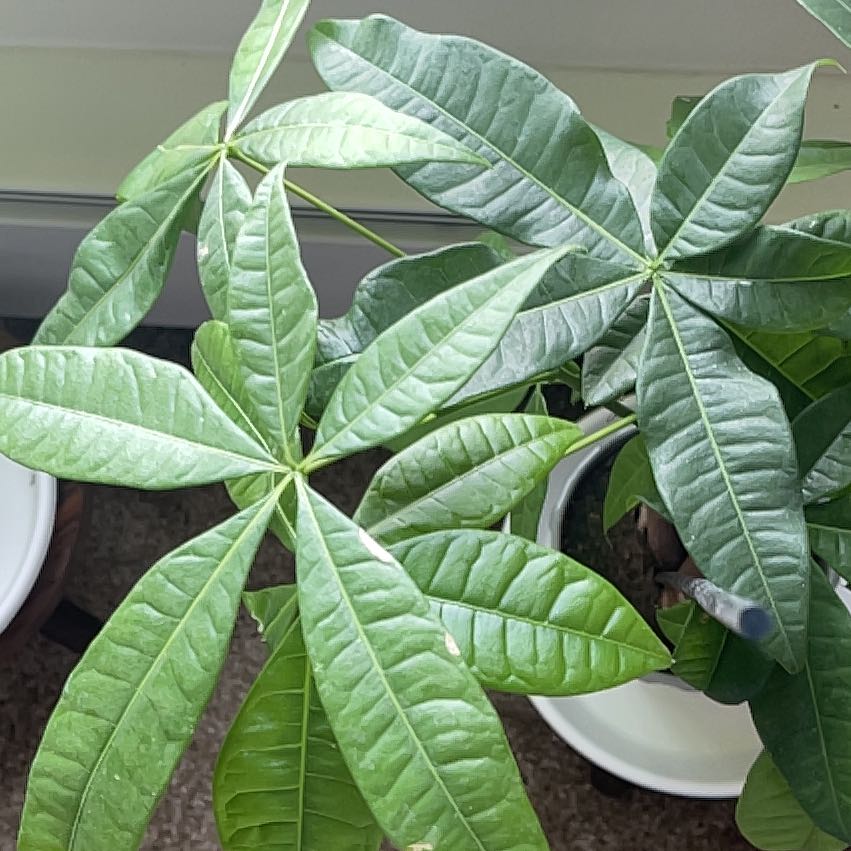
Money Tree

What's Wrong with My Money Tree?

Pachira aquatica
Reviewed by Kiersten Rankel M.S.
Quick Answer
1.
Most Money Tree problems come down to watering.
Overwatering is far more common than underwatering. Check the soil before reaching for the watering can.
2.
Yellow leaves dropping is a watering signal.
Check the soil first. Wet and squishy means overwatering. Bone dry and pulling away from the pot edges means underwatering. Fix the watering and the plant stabilizes.
3.
New palmate leaves on top mean it's still healthy.
Money Tree sheds old leaves while pushing fresh fans from the top. Healthy new growth means recovery is possible.
Stay on top of plant care
Get seasonal reminders for watering and fertilizing โ€” personalized for your plants.
Try Greg Free

Common Money Tree Problems

Yellow leaves dropping

Overwatering

Money Tree roots evolved in seasonally flooded Central American swamps, but those floodwaters move. In a pot the roots just sit, and soggy soil suffocates them fast. The plant pulls nutrients back from its oldest leaves first, turning them yellow before they drop.

1. Stop watering and let the top 2โ€“3 inches of soil dry out fully
2. Empty any standing water from the saucer or decorative cachepot
3. If yellowing keeps spreading, unpot and cut soft or brown roots back to firm white tissue
4. Repot in fresh, well-draining mix in a pot with a drainage hole
Underwatering

When the soil stays bone dry for too long, even the braided trunk's moisture reserves run out. The plant sheds older leaves to reduce its water demand, and the remaining leaves may go yellow and feel papery before they fall.

1. Water thoroughly until it drains from the bottom
2. If the soil is pulling away from the pot edges, bottom-soak for 20 minutes then top-water
3. Shorten the interval between waterings slightly going forward
Normal leaf shedding

Money Tree sheds its oldest leaves throughout the year as it grows fresh palmate leaflets at the top of each trunk. A few yellow leaves falling off while new growth continues at the top is normal.

Drooping leaves

Underwatering

Money Tree's large palmate leaves, each with 5โ€“7 elongated leaflets, lose moisture fast through transpiration. When the pot runs dry the leaflets sag downward from the central point and may curl or hang limp. Recovery is usually fast, within a day of a thorough watering.

Check the soil a few inches down. If it's dry all the way through, water thoroughly until it drains. Bottom-soak for 20 minutes if the soil has fully dried and is pulling away from the edges. Resume watering when the top 2โ€“3 inches are dry.
Low humidity

Money Trees are native to humid tropical wetlands and want 50%+ humidity indoors. In dry air the leaflets curl inward along their midrib to reduce water loss, and brown crispy tips usually appear at the same time. Check humidity before assuming thirst.

Run a humidifier nearby, aiming for 50% or above. Group the plant with other houseplants to raise local humidity. Move it away from heating and AC vents, which dry the air fast.

Brown tips

Low humidity

The fine tips of Money Tree's long leaflets are the first to desiccate in dry air. Brown edges creep inward from the tip of each finger in the palmate leaf, and the tissue feels papery or crispy to the touch. Heat vents and AC drafts accelerate it.

Raise humidity to 50%+ with a humidifier or by grouping plants together. Move the plant away from heating and cooling vents. Trim browned tips back to green tissue with clean scissors if the appearance bothers you.
Fluoride or salt buildup

Money Trees are sensitive to the fluoride in tap water and to fertilizer salt accumulating in the soil over time. Both cause tip burn that starts at the very end of each leaflet, and it looks nearly identical to humidity damage.

Switch to filtered, distilled, or rainwater. Flush the soil every few months by watering heavily until it drains freely, which leaches built-up salts. If using fertilizer, reduce the dose and never apply it to dry soil.

Mushy trunk

Root rot

The braided trunk sold in stores is 3โ€“5 young Pachira stems twisted together while still flexible, with their bases sharing the same soil. When roots rot from chronic overwatering or a pot with no drainage, the rot climbs up through each braided stem. Once any section of the trunk is soft past the soil line, the damage spreads fast.

1. Unpot immediately and feel along the braid to find where firm tissue ends
2. Cut every stem that is soft or discolored back to firm green tissue
3. If at least one trunk is still firm, repot just the healthy sections in dry, well-draining mix
4. Do not water again until the top half of the soil is dry and new leaf growth appears

Sudden leaf drop

Environmental shock

Money Trees are unusually reactive to change. Moving the plant to a new spot, a cold draft from an open window, or a temperature swing near a vent can trigger the plant to shed a large portion of its canopy at once. The reaction looks alarming but usually stabilizes within two to three weeks once conditions are stable.

1. Return the plant to its previous location if you recently moved it
2. Move it away from cold drafts, heat vents, and AC vents
3. Hold the watering cadence steady and give it two to three weeks to recalibrate
4. Skip repotting, fertilizing, and pruning until new leaves appear

Pests

Spider mites

Fine webbing on the undersides of leaflets, with pale yellow stippling on the upper surface. Dry indoor air is the main invitation, and Money Tree's dense canopy of palmate leaves gives mites plenty of sheltered surfaces to colonize before you notice.

1. Rinse the plant under a strong shower to knock mites off
2. Wipe each leaflet top and bottom with insecticidal soap or 70% isopropyl on a cloth
3. Repeat every 3โ€“4 days for two weeks
4. Raise humidity to 50%+, which makes conditions hostile for mites
Scale

Flat, shell-like brown bumps stuck to the stems and leaflet undersides, often with sticky honeydew on leaves below. Scale attaches to Money Tree's woody braided trunks and is easy to miss until a stem looks rough or feels sticky, since the braid's seams give them cover.

1. Scrape off individual scale with a soft toothbrush or fingernail
2. Wipe the stems and leaf undersides with a cotton pad soaked in 70% isopropyl
3. Follow up with an insecticidal soap spray, working into the braid seams
4. Check every week for a month, since eggs hatch in waves

Preventing Money Tree Problems

A few consistent habits prevent most of what goes wrong.
Weekly Check
1
Water when the top 2โ€“3 inches of soil are dry, not on a fixed schedule.
Stick a finger or a skewer into the soil before every watering. This single habit prevents both overwatering and underwatering, which together cause most Money Tree problems.
2
Always use a pot with a drainage hole.
Money Trees are often sold in decorative cachepots with no drainage. Move the plant into a nursery pot with holes or check frequently that water is not pooling at the base. Standing water is how rot starts.
3
Keep humidity at 50% or above.
A humidifier or a cluster of plants prevents brown leaflet tips, leaf curl, and most spider mite outbreaks. Heating and AC vents are the main enemy here, so position the plant away from them.
4
Pick a stable spot and leave the plant there.
Money Trees shed leaves in response to every move. Bright indirect light and a consistent location prevent the stress-triggered leaf drops that owners often mistake for a care problem.
5
Use filtered or rainwater when possible.
Tap water fluoride and salt accumulate in the soil and slowly burn the leaflet tips. Flushing the pot with a heavy watering every few months also helps clear buildup if you're using tap.
Stay on top of plant care
Get seasonal reminders for watering and fertilizing โ€” personalized for your plants.
Try Greg Free

About This Article

Kiersten Rankel M.S.
Botanical Data Lead at Greg ยท Plant Scientist
About the Author
Kiersten Rankel holds an M.S. in Ecology & Evolutionary Biology from Tulane University. A certified Louisiana Master Naturalist, she has over a decade of experience in science communication, with research spanning corals, cypress trees, marsh grasses, and more. At Greg, she curates species data and verifies care recommendations against botanical research.
See Kiersten Rankel's full background on LinkedIn.
Editorial Process
Every problem and fix in this article was verified against Greg's botanical database, cross-referenced with USDA hardiness zone data and horticultural research from Missouri Botanical Garden and the University of Florida IFAS Extension. The Pachira aquatica care profile reflects both documented wetland-tree biology and the practical quirks of growing braided specimens in indoor conditions, informed by years of community grower feedback in Greg.
53,913+ Greg users growing this plant
USDA hardiness zones 10aโ€“12b