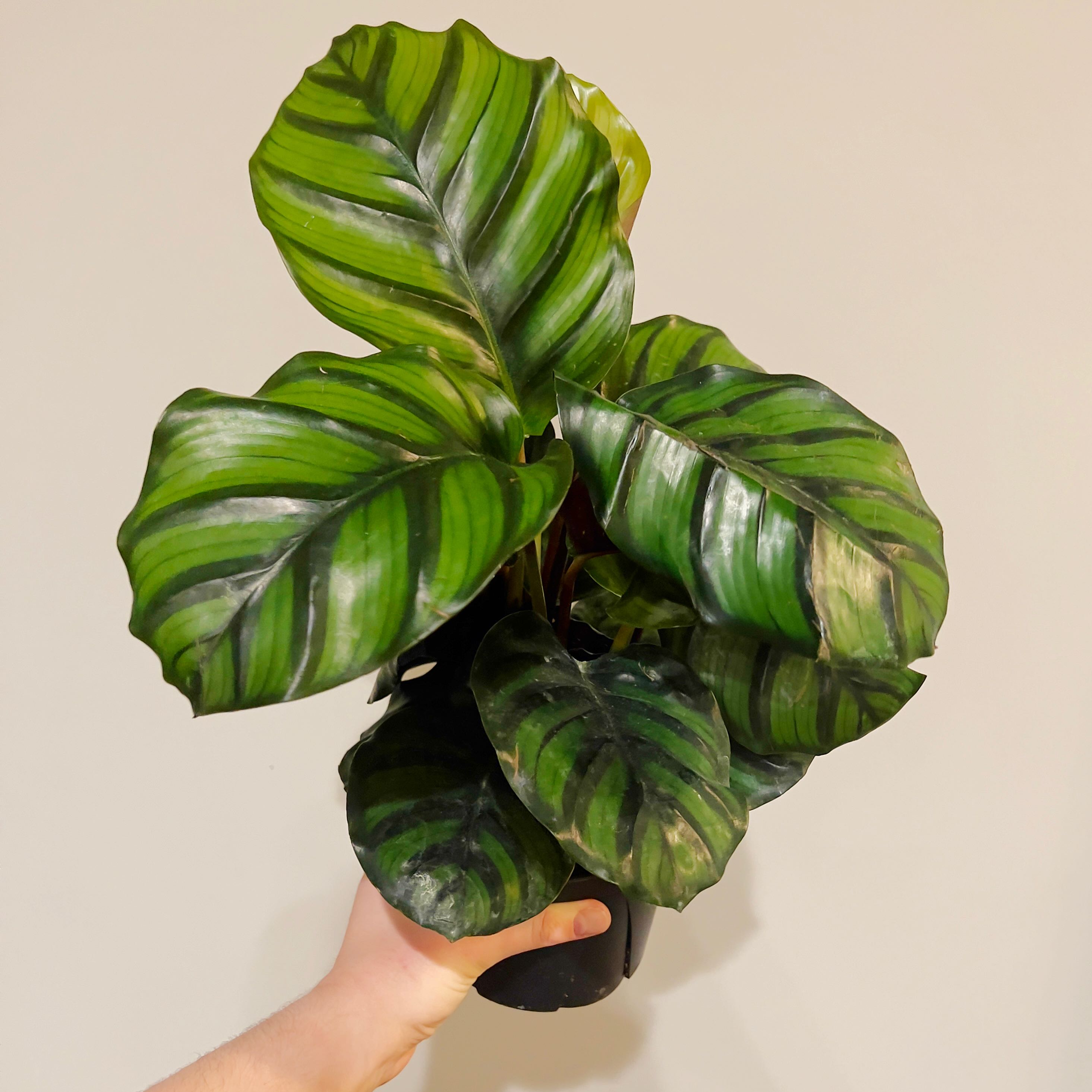
Calathea fasciata

How to Fertilize Calathea fasciata

Goeppertia fasciata
Reviewed by Kiersten Rankel M.S.
Quick Answer
Feed your Calathea fasciata with a balanced liquid fertilizer (10-10-10) diluted to quarter strength once a month during spring and summer. Calatheas are extremely sensitive to fertilizer salts, so gentle, infrequent feeding is always the safer approach. Stop feeding in winter.

When Should I Start Feeding My Calathea fasciata?

Start fertilizing your Calathea fasciata in mid-spring once new leaves are actively unfurling, as this plant responds to increasing daylight hours rather than outdoor temperatures.

US feeding regions map
Pacific Mar–Sep
Mountain May–Aug
Midwest Apr–Sep
Northeast May–Sep
Southeast Mar–Oct
Stay on top of plant care
Get seasonal reminders for watering and fertilizing — personalized for your plants.
Try Greg Free

How Often Should I Fertilize My Calathea fasciata?

Once a month at quarter strength during spring and summer is the right cadence for Calathea fasciata. Feeding more often than this almost always causes more harm than good with this genus.

Taper to every 6-8 weeks in early fall, then stop completely through winter. Calatheas slow down significantly when light levels drop, and any unused nutrients just build up as salts in the soil.

Brown, crispy leaf margins are the classic sign of overfertilizing (or tap water minerals). If you see this pattern, flush the soil thoroughly and skip the next couple of feedings. Consider switching to distilled or filtered water as well, since Calatheas are sensitive to fluoride and chlorine.

Feeding Calendar
Spring & Summer
Quarter-strength balanced liquid once a month
Early Fall
Quarter-strength every 6-8 weeks, tapering off
Late Fall & Winter
No feeding

What Is the Best Fertilizer for Calathea fasciata?

A balanced liquid fertilizer (10-10-10 or 20-20-20) diluted to one-quarter of the label strength is the safest option for Calathea fasciata. This plant is notoriously sensitive to fertilizer salts, and even moderate doses can trigger the brown, crispy leaf edges that Calathea owners dread.

Liquid fertilizer is the only recommended type. Slow-release granules and fertilizer spikes create concentrated zones of nutrients in the soil that Calathea roots react to poorly.

Avoid any fertilizer that lists urea as the primary nitrogen source. Calatheas process urea inefficiently, and the byproducts can cause root damage. Look for formulas with nitrate or ammoniacal nitrogen instead.

Synthetic
Complete formula with all 16 essential nutrients and no urea. Dilute to 1/16 teaspoon per gallon for this salt-sensitive plant.
Balanced water-soluble powder. Use at one-quarter strength (about 1/8 teaspoon per gallon) for Calathea.
Organic
Very gentle organic liquid with a low concentration that makes it nearly impossible to overfeed sensitive plants like Calathea.
The gentlest option available. Sprinkle a thin layer on the soil surface every 2-3 months. Zero risk of salt burn.

How Do I Fertilize My Calathea fasciata?

1
Water with filtered water first
Thoroughly moisten the soil using filtered or distilled water before fertilizing. Calathea fasciata is sensitive to tap water minerals, and adding fertilizer on top of fluoride and chlorine compounds the salt stress.
2
Dilute to quarter strength
Mix your balanced liquid fertilizer at one-quarter of the label dose. For most concentrates, this works out to about 1/8 teaspoon per gallon. Err on the side of weaker.
3
Apply to the soil only
Pour the diluted solution slowly onto the soil surface. Keep it off the leaves entirely. Fertilizer residue on Calathea foliage can cause spots and interfere with the stomata on the undersides of the leaves.
4
Drain and empty the saucer
Let all excess solution flow out the bottom and discard it. Calathea roots sitting in fertilizer-laden water will develop brown tips within days.
5
Flush with plain water between feedings
At least once between fertilizer applications, water deeply with plain filtered water to rinse accumulated salts from the soil. This single step prevents most Calathea fertilizer problems.

Got More Questions?

Can I use coffee grounds on my Calathea fasciata?
Avoid coffee grounds for Calathea. They add unpredictable amounts of acid and can compact the soil, reducing the aeration that Calathea roots need. A dilute liquid fertilizer gives you much more control.
What happens if I over-fertilize my Calathea fasciata?
Brown, crispy edges on the leaves are the telltale sign. In severe cases, the leaf tips curl and entire leaves may yellow. Flush the soil with several rounds of distilled water and stop feeding for at least 6-8 weeks.
Should I use distilled water when fertilizing?
Yes, ideally. Tap water contains fluoride and chlorine that Calatheas react to poorly. Mixing your dilute fertilizer with distilled or filtered water avoids stacking mineral stress on top of fertilizer salts.
Why are my Calathea's leaf edges browning even though I barely fertilize?
Brown edges on Calathea are often caused by tap water minerals or low humidity rather than fertilizer. Try switching to distilled water and raising humidity above 50% before adjusting your feeding schedule.
Can I use a slow-release fertilizer for Calathea?
Slow-release granules are not recommended. They release nutrients unevenly and create concentrated zones in the soil that Calathea roots cannot tolerate. Stick with dilute liquid fertilizer for the most controlled delivery.
Stay on top of plant care
Get seasonal reminders for watering and fertilizing — personalized for your plants.
Try Greg Free

About This Article

Kiersten Rankel M.S.
Botanical Data Lead at Greg · Plant Scientist
About the Author
Kiersten Rankel holds an M.S. in Ecology & Evolutionary Biology from Tulane University. A certified Louisiana Master Naturalist, she has over a decade of experience in science communication, with research spanning corals, cypress trees, marsh grasses, and more. At Greg, she curates species data and verifies care recommendations against botanical research.
See Kiersten Rankel's full background on LinkedIn.
Editorial Process
Fertilizer recommendations verified against Goeppertia fasciata growth data from Greg's botanical database, cross-referenced with USDA hardiness zone data and published horticultural research.
53+ Greg users growing this plant
USDA hardiness zones 10a–12b
Citations:
NC State Extension