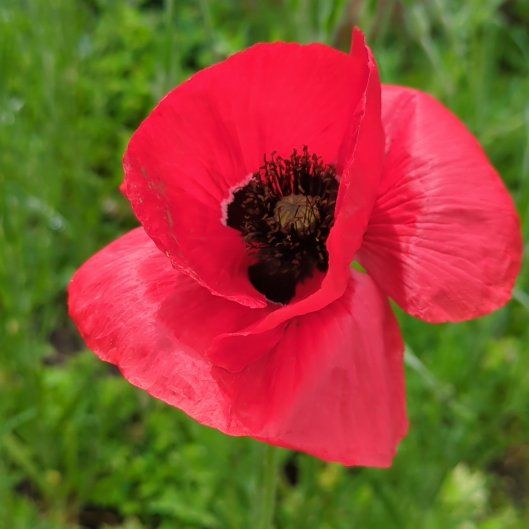
Common Poppy

What's Eating Your Common Poppy?

Papaver rhoeas
Reviewed by Kiersten Rankel M.S.
Quick Answer

For common poppy, the most likely culprits are aphids clustered tightly on flower buds and stalks, and slugs chewing young basal rosettes overnight in spring. Spider mites show up only on drought-stressed plants in hot dry summers. The milky white latex sap that bleeds from cut stems makes Papaver rhoeas more pest-resistant than most annual wildflowers.

Stay on top of plant care
Get seasonal reminders for watering and fertilizing, personalized for your plants.
Try Greg Free

What does the damage look like?

Tap the closest match to jump straight to the fix.

Pests, ranked by impact

Dense colony of aphids clustered on a plant stem

Aphids

Damage
Medium
Removal
Easy
What it looks like

Tiny pear-shaped insects 1 to 3 mm long, in shades of green, black, or pink. Cluster densely along flower stalks and packed tightly around the swelling buds just before the iconic red petals open. The classic poppy pest, often the only insect pressure a home grower sees.

What the damage looks like

Buds open misshapen or fail to open at all when colonies are heavy. Stalks bend and twist where aphids feed. A sticky shiny film coats the stems and the leaves below, sometimes followed by black sooty mold. Petals can drop early or emerge with chewed-looking edges.

How to get rid of them
Option 1

Strong water blast every 2 to 3 days for 2 weeks

Hold a hose nozzle 12 inches from the affected buds and stalks and spray at high pressure. Aphids dislodge and rarely make it back. The fern-like leaves and tall flower stalks of common poppy take a hard rinse without breaking. Repeat every 2 to 3 days for 2 weeks through the bud stage.

Option 2

Insecticidal soap on stalks and buds at dusk

Spray ready-to-use insecticidal soap (Safer Insect Killing Soap, ~$10) directly on aphid clusters along the flower stalks at dusk. Soap kills on contact and breaks down by morning so it won't bother bees visiting open blooms. Repeat every 5 days for 2 to 3 rounds until the bud stalks are clean.

Option 3

Plant alyssum or yarrow nearby for ladybug habitat

Sow sweet alyssum or plant yarrow within 3 feet of the poppy patch. These low growers attract ladybugs and lacewings, which feed heavily on aphids. Common poppy self-seeds and comes back every year in the same spot, so an established companion planting keeps aphid pressure low season after season.

Large red-brown slug (Arion rufus) crawling on a rhubarb leaf

Slugs

Damage
Medium
Removal
Moderate
What it looks like

Soft slimy mollusks 1 to 4 inches long, gray, brown, or tan. Hide under mulch, pots, and stones during the day. Feed at night on the young basal rosette of fern-like leaves. The bigger threat is to seedlings and first-year rosettes, not established stalks.

What the damage looks like

Ragged holes chewed through the divided leaves of the basal rosette overnight, with no clean cut. Silvery slime trails on leaves, soil, and nearby stones in the morning. Severe pressure can mow a seedling patch down to bare stems. Mature flower stalks with milky latex are mostly left alone.

How to get rid of them
Option 1

Iron phosphate bait around the rosettes at dusk

Scatter iron phosphate slug bait (Sluggo, ~$15) lightly around the base of seedlings and rosettes at dusk after a watering. Slugs eat it and stop feeding within hours. Pet-safe and breaks down into fertilizer. Reapply weekly through cool wet spring weather until the rosettes are big enough to outgrow the damage.

Option 2

Hand-pick at night with a flashlight

1

Walk the poppy patch an hour after sunset on the first damp evening with a flashlight.

2

Check under leaves, mulch, and any boards or pots near the rosettes. Pick slugs by hand into a jar of soapy water.

3

Repeat 2 or 3 nights in a row. The first sweep catches the breeding adults and pressure drops fast.

Option 3

Pull mulch back from the base of seedlings

Common poppy seedlings need bare soil right around the rosette. Slugs hide in damp mulch and shelter close to the food. Keep a 4-inch ring of bare soil around each young plant until the rosette is the size of your hand. The exposed soil dries out and slugs avoid the crossing.

Common myth

Beer traps clear a slug problem.

Beer traps catch a few slugs but draw more in from neighboring yards than they kill. The patch ends up with more pressure, not less, and the traps need refilling every few days. Iron phosphate bait is cheaper, lasts longer, and actually reduces the population.

Spider mite infestation on a stem with fine silk webbing and pale speckled leaf damage

Spider mites

Damage
Low
Removal
Easy
What it looks like

Almost invisible without a hand lens. Yellow-green to red-orange specks on the underside of the finely divided fern-like leaves. Only show up on poppies pushed past their drought tolerance in hot dry late-summer weather. A healthy well-watered poppy almost never sees them.

What the damage looks like

Tiny pale yellow dots scattered across the upper leaf surface, then a dull bronzed look as feeding spreads. Fine webbing between the divided leaflets in heavy infestations. The damage is cosmetic on a plant that finishes its annual cycle by midsummer anyway. Watch the leaves more than treat them.

How to get rid of them
Option 1

Water deeply at the base every 4 to 5 days in heat

Spider mites breed fast on drought-stressed plants. Soak the soil at the base every 4 to 5 days through any hot dry stretch. Common poppy is a tough annual that doesn't need pampering, but a stressed plant invites mites. Consistent water alone usually drops the population without spraying.

Option 2

Hose down foliage in the cool morning

Spray the underside of the divided leaves with a strong jet of water early in the morning. Mites can't hold on and humid leaves slow survivors. The fern-like foliage takes the rinse well and dries by midday. Repeat every 3 days for a week if dots persist.

Stay ahead of all of them

Three habits that keep common poppy nearly pest-free through its short annual cycle.
1

Bud and stalk check, every few days in spring

Aphids show up on the swelling flower buds and along the stalks just before the red petals open. A 30-second scan every few days through bud stage catches a colony while it's still on one or two stalks, before it spreads through the patch.

2

Protect first-year rosettes from slugs

Slugs only matter while the basal rosettes are young. Bait or pick during the first 4 to 6 weeks after germination. Once the flower stalks rise and the milky latex sap kicks in, slug damage drops to almost nothing on its own.

3

Let the patch self-seed where it stands

Common poppy drops seed at the end of its cycle and comes back in the same spot every year. Don't deadhead the last round of blooms. The next generation starts ahead of weeds and pest pressure stays low because the timing is right for the local pollinators and predators.

4

Water the patch through hot dry weeks

Spider mites only show up on drought-stressed poppies in hot late-summer heat. A deep soak every 4 to 5 days during any dry stretch keeps the plants vigorous and the leaves mite-free. The milky latex stays flowing in well-hydrated stems and that's what makes the plant pest-resistant in the first place.

Stay on top of plant care
Get seasonal reminders for watering and fertilizing, personalized for your plants.
Try Greg Free

About This Article

Kiersten Rankel M.S.
Botanical Data Lead at Greg · Plant Scientist
About the Author
Kiersten Rankel holds an M.S. in Ecology & Evolutionary Biology from Tulane University. A certified Louisiana Master Naturalist, she has over a decade of experience in science communication, with research spanning corals, cypress trees, marsh grasses, and more. At Greg, she curates species data and verifies care recommendations against botanical research.
See Kiersten Rankel's full background on LinkedIn.
Editorial Process
Pest identification and treatment guidance verified against Papaver rhoeas field reports from Greg's botanical database, cross-referenced with university extension sources and published horticultural research.