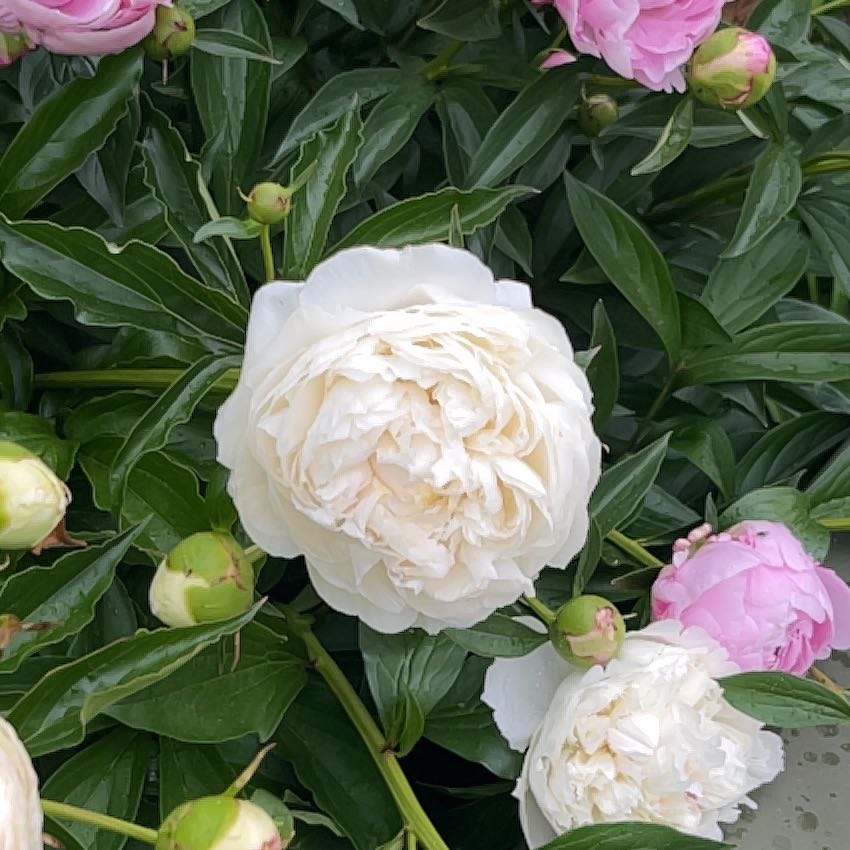
Chinese Peony

What's Eating Your Peony?

Paeonia lactiflora
Reviewed by Kiersten Rankel M.S.
Quick Answer

For peony, the most likely culprits are thrips (silvery scarred buds that open distorted or fail to open) and rose chafers (bronze beetles that skeletonize leaves and chew petals during the May to June bloom window). Aphids cluster densely on developing bud stalks in spring and weaken the bloom flush.

Stay on top of plant care
Get seasonal reminders for watering and fertilizing, personalized for your plants.
Try Greg Free

What does the damage look like?

Tap the closest match to jump straight to the fix.

Pests, ranked by impact

Slender adult thrips (Frankliniella sp.) on a flower petal

Thrips

Damage
High
Removal
Hard
What it looks like

Slender pale yellow to brown insects under 2 mm long. Hide deep inside developing peony buds and between the overlapping petals as flowers open. So small they look like moving dust specks. Worst on light-colored bloom forms (white, pale pink) where the scarring shows.

What the damage looks like

Silvery or papery scars on the outside of swelling buds. Buds that do open often unfurl with brown-edged petals or distorted petal shape. Heavy infestations cause buds to abort entirely or open as malformed blooms. The damage targets the entire reason most growers plant peony.

How to get rid of them
Option 1

Blue sticky traps at bud-swell, every 2 weeks

Hang blue sticky traps (Trappify or Garsum, ~$10) at the height of developing buds two weeks before normal bloom time. Thrips key on blue. The traps catch flying adults before they enter the buds where sprays can't reach. Replace every 2 weeks through the bloom window.

Option 2

Spinosad on developing buds, every 5 days

1

Mix spinosad (Captain Jack's Deadbug Brew or Monterey Garden Insect Spray, ~$12 to $15) per label rate.

2

Spray developing buds and the leaves and stems just below them at dusk, starting when buds are pea-sized.

3

Repeat every 5 days until petals begin to color, then stop. Spinosad is hard on bees once flowers open.

Option 3

Cut spent blooms and clear all litter at season end

Thrips overwinter as pupae in soil and plant debris under the clump. Cut peony stems to the ground after frost and rake out every bit of leaf litter from around the crown. Bag it and dispose. Do not compost. A clean clump entry catches them before they emerge in spring.

Small leaf weevil resting on a green leaf

Rose chafers

Damage
High
Removal
Moderate
What it looks like

Long-legged tan to bronze beetles about 12 mm long with reddish-brown heads. Emerge in massive synchronized swarms in late May and early June, exactly when peony blooms. Most common east of the Rockies on sandy soils. Feed in groups, often piling onto a single open flower or leaf.

What the damage looks like

Lacy skeletonized peony leaves with only the veins left intact. Chewed ragged holes through the petals of open blooms, sometimes with beetles still feeding inside the flower. Damage hits during the 4 week bloom window and ruins both foliage and the prized flower display in one pass.

How to get rid of them
Option 1

Hand-pick into soapy water at dawn, daily for 2 weeks

1

Walk the clump at dawn or dusk when chafers are sluggish and slow.

2

Knock beetles off the deeply lobed leaves and out of open flowers into a jar of soapy water. They drown in seconds.

3

Repeat daily through the bloom window (roughly late May through mid June). The swarm only lasts about 4 weeks each year.

Option 2

Floating row cover over the clump until first color

Drape lightweight floating row cover (Agribon AG-19, ~$20) over the clump on the day buds first show color. Anchor the edges with stones or landscape staples. Remove just before flowers fully open so pollinators can reach them. The barrier blocks chafers during the worst feeding days.

Option 3

Skip the chafer-trap pheromone lures

Avoid pheromone traps marketed for rose chafers or Japanese beetles. The lures pull more beetles in from the surrounding neighborhood than they catch. The clump ends up worse, not better. Hand-picking and row covers work much better in a small garden.

Dense colony of aphids clustered on a plant stem

Aphids

Damage
Medium
Removal
Easy
What it looks like

Tiny pear-shaped insects 1 to 3 mm long, in shades of green, brown, or pink. Cluster densely on the bud stalks just below developing flower buds and on the soft new shoots in spring. Fastest population growth happens during the 3 week run-up to bloom.

What the damage looks like

Dense colonies coating the bud stalk just below the flower. Stalks may bend or buds may abort if pressure is heavy. A sticky shiny film coats lower leaves and the soil below the clump. Black sooty mold grows on the residue if left untreated. Bloom quality drops on heavily infested stems.

How to get rid of them
Option 1

Strong water blast every 2 to 3 days for 2 weeks

Hold a hose nozzle 12 inches from the bud stalks and spray at high pressure. Most aphids dislodge and don't make it back to the clump. Repeat every 2 to 3 days for 2 weeks. The fastest, cheapest fix and works without chemicals or risk to the bees that visit open peony blooms.

Option 2

Insecticidal soap on bud stalks at dusk

Spray ready-to-use insecticidal soap (Safer or Bonide, ~$12) directly on the aphid colonies at dusk. Coat the bud stalks and the underside of the lowest leaves. Soap kills only on contact, so direct hit matters. Repeat every 4 days for 2 weeks. Stop spraying once buds show color and pollinators arrive.

Option 3

Plant alyssum or yarrow nearby for ongoing pressure

Plant alyssum, dill, or yarrow within 3 feet of the peony clump. These attract ladybugs and lacewings, which feed on aphids. Established plantings keep spring aphid pressure low without sprays and pay off year after year because peonies live 50 years or more in the same spot.

Common myth

Ants on peony buds are damaging the flowers.

Ants are drawn to the sweet nectar peony buds secrete from extrafloral nectaries. They do no harm to the buds, the petals, or the plant. Ants also do not help blooms open. The flowers open just fine without them. Leave the ants alone and don't spray the buds. Killing the ants with insecticide on a developing bud is far more damaging than the ants ever were.

Stay ahead of all of them

Four habits that protect peony's prized May to June bloom window.
1

Bud-stalk and leaf-axil scout, every 3 days in May

Thrips, aphids, and chafers all peak during the 4 week run-up to peony bloom. A 30-second scan of the bud stalks and the leaf axils every 3 days through May catches every problem early enough to act before it hits the flowers.

2

Cut stems to the ground after first hard frost

Peony foliage harbors thrips pupae through winter if left in place. A full ground-level cut in late fall, with all litter raked clear of the crown, removes the next season's pest pressure before it can emerge. The clump comes back clean every spring.

3

Plant in full sun with strong air movement

Peonies need 6 hours of direct sun and good airflow around the clump. Crowded clumps stay damp and become pest and disease magnets. Give each clump 3 feet of clear space on all sides. The dry surrounding air discourages thrips, aphids, and the chafers that ride in on still humid days.

4

Resist the urge to dig and divide young clumps

Peonies resent transplanting and a stressed clump is a pest magnet. Leave a healthy clump in place. The plants live 50 years or more and bloom best after a clump has settled in for at least 3 years. Divide only when bloom production drops noticeably, never as routine maintenance.

Stay on top of plant care
Get seasonal reminders for watering and fertilizing, personalized for your plants.
Try Greg Free

About This Article

Kiersten Rankel M.S.
Botanical Data Lead at Greg · Plant Scientist
About the Author
Kiersten Rankel holds an M.S. in Ecology & Evolutionary Biology from Tulane University. A certified Louisiana Master Naturalist, she has over a decade of experience in science communication, with research spanning corals, cypress trees, marsh grasses, and more. At Greg, she curates species data and verifies care recommendations against botanical research.
See Kiersten Rankel's full background on LinkedIn.
Editorial Process
Pest identification and treatment guidance verified against Paeonia lactiflora field reports from Greg's botanical database, cross-referenced with university extension sources and published horticultural research.