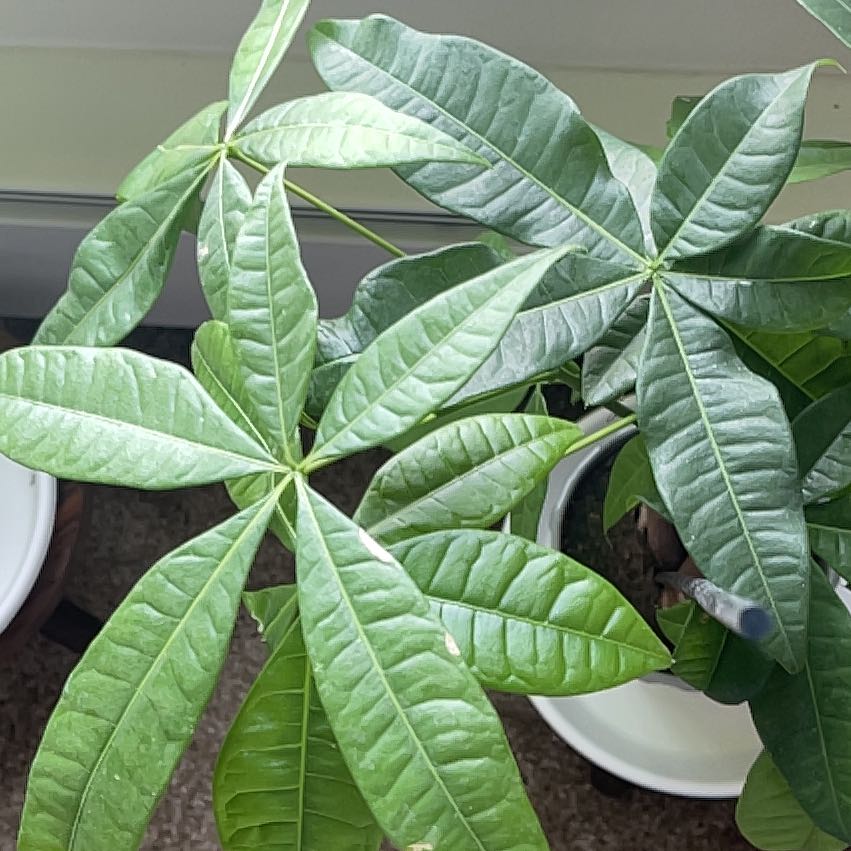
A glazed ceramic or plastic pot with drainage holes works best for a Money Tree. Choose a pot 1-2 inches wider than the root ball. Money Trees store water in their thick trunks and do not like soggy soil, so good drainage is more important than moisture retention.
What Size Pot Does a Money Tree Need?
Money Tree has a moderately vigorous root system that grows in proportion to the braided or single trunk above. A pot 1-2 inches wider than the root ball gives the roots space to grow without leaving excess wet soil.
Money Trees grow fairly quickly indoors, so plan to size up every 1-2 years while the plant is young. A mature indoor specimen typically tops out in a 12-16 inch pot, depending on whether the trunk is braided or single.
If the plant seems top-heavy, tips over easily, or the soil dries out within a day of watering, it is time for a bigger pot.
Small braided tree (under 1 ft)5–6" pot
Medium tree (1–3 ft)8–10" pot
Large tree (3–5 ft)12–14" pot
Mature specimen (5+ ft)14–16" pot
What Material Pot Is Best for Money Tree?
Money Tree stores water in its swollen trunk, so the roots prefer soil that dries out a bit between waterings. While the plant originates from swampy areas in Central and South America, potted specimens are prone to root rot when soil stays constantly wet.
The root system is not especially delicate, but it does best with moderate moisture and good aeration. Any material that provides drainage without extreme drying works well.
Dries fastest → Slowest
Best for Money Tree
Fabric
Dries out faster than most pots, so water a bit more often. Good airflow benefits the roots.
Unglazed Ceramic
Breathable and provides helpful weight to keep taller Money Trees from tipping over.
Wood
A solid option that offers moderate moisture retention and a natural look.
Glazed Ceramic
Retains moisture well while still looking polished. A popular choice for indoor Money Trees.
Plastic
Lightweight and holds moisture. Works great, especially with a decorative outer pot for stability.
Metal
Fine for indoor use. The weight helps stabilize tall braided trunks. Avoid in direct outdoor sun.
Money Trees are easygoing about pot materials, so you can choose based on what fits your space. Every option on the spectrum works, from fast-draining fabric to moisture-holding metal.
If your Money Tree has a tall braided trunk, lean toward heavier materials like ceramic or metal. The extra weight keeps it from toppling over when you bump into it or a breeze catches the leaves.
Stay on top of plant care
Get seasonal reminders for watering and fertilizing — personalized for your plants.
Yes. Despite coming from wetland habitats, potted Money Trees are very susceptible to root rot when water sits at the bottom of the container. Drainage holes are the simplest way to prevent this.
If you have a decorative pot without holes, keep the plant in its nursery pot inside the outer container. After watering, let the nursery pot drain fully before placing it back. Never let the Money Tree sit in standing water.
When Should I Repot My Money Tree?
Money Tree grows fairly quickly and typically needs repotting every 1-2 years while young. Once it reaches its mature container size, every 2-3 years is plenty. Repot in spring or early summer for the best recovery.
When repotting, be gentle with the roots and keep the trunk at the same soil level. If the trunk is braided, check that the braids are not too tight, since they can girdle the trunks as they thicken.
Water thoroughly after repotting and place the plant in bright, indirect light. Avoid fertilizing for 3-4 weeks to let the roots settle into the new soil.
Signs It's Time to Repot
Roots circling the bottom of the pot
Water runs straight through without soaking in
Plant becomes top-heavy and tips over
Leaves yellowing despite proper watering and light
Soil dries out within two days of watering
When Can I Plant My Money Tree in the Ground?
Money Tree can go in the ground year-round in USDA zones 10a through 12b. It grows best in partial shade with moist, well-drained soil. In the landscape, it can reach 20-30 feet tall, which is much larger than its usual indoor size.
In cooler zones, Money Tree should stay in a container. It has no frost tolerance, and temperatures below 50F can cause leaf drop and stress. If you move it outdoors for summer, bring it back inside well before nighttime temperatures dip into the 40s.
Got More Questions?
Can I use a pot without drainage holes for a Money Tree?
It is not recommended. Money Trees are prone to root rot in soggy soil. Use a pot with drainage holes, or place a nursery pot inside a decorative cachepot and drain after watering.
How do I know if my Money Tree's pot is too big?
If the soil stays wet for more than a week after watering, the pot is oversized. Excess wet soil around roots the plant has not reached creates conditions for rot.
Does my braided Money Tree need a bigger pot than a single-trunk one?
Usually yes. A braided Money Tree has 3-5 trunks sharing one pot, so the combined root mass fills the container faster. Size up when you see roots crowding.
Can I keep my Money Tree in a very small pot to limit growth?
You can slow growth this way, but a severely root-bound Money Tree will drop leaves and look stressed. A slightly snug pot is fine, but do not let it become severely cramped.
Should I use a saucer under my Money Tree?
Yes, to protect your surface from water. But empty the saucer within an hour of watering. Standing water in the saucer has the same effect as no drainage hole.
Stay on top of plant care
Get seasonal reminders for watering and fertilizing — personalized for your plants.
Kiersten Rankel holds an M.S. in Ecology & Evolutionary Biology from Tulane University. A certified Louisiana Master Naturalist, she has over a decade of experience in science communication, with research spanning corals, cypress trees, marsh grasses, and more. At Greg, she curates species data and verifies care recommendations against botanical research.
See Kiersten Rankel's full background on LinkedIn.
Editorial Process
Container guidance verified against Pachira aquatica growth data from Greg's botanical database, cross-referenced with USDA hardiness zone data and published horticultural research.