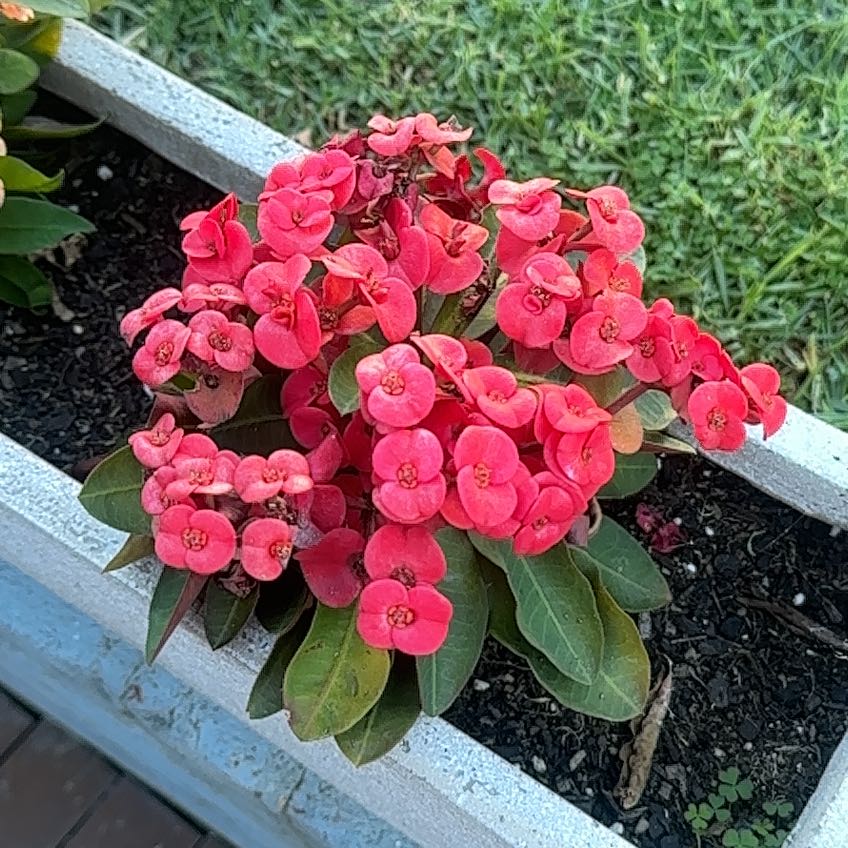
Crown of Thorns does best in unglazed ceramic or terracotta pots with drainage holes. Choose a pot just slightly wider than the rootball. This succulent stores water in its thick stems and prefers to dry out completely between waterings, so fast-draining soil and a breathable pot are key.
What Size Pot Does a Crown of Thorns Need?
Crown of Thorns has a compact, fibrous root system that does not need much space. Pick a pot about 1-2 inches wider than the rootball. This plant grows slowly to moderately, reaching about 3 feet tall and 2 feet wide at maturity, so you will size up only occasionally.
A slightly snug pot actually encourages more blooms. Crown of Thorns tends to focus on flower production when its roots are mildly crowded rather than expanding into a large soil volume.
Choose a pot with some weight to it. Mature plants get top-heavy with their thick, thorny stems, and a lightweight pot tips easily.
Young plant (under 6 in)4–5" pot
Established plant (6–12 in)6–8" pot
Mature plant (1–2 ft)8–10" pot
Large specimen (2–3 ft)10–14" pot
What Material Pot Is Best for Crown of Thorns?
Crown of Thorns is a succulent from Madagascar that stores water in its thick stems and has evolved for dry, well-drained conditions. Its roots are prone to rot in constantly moist soil, so the pot should help the soil dry out between waterings rather than trapping moisture.
Breathable materials that let moisture escape through the pot walls are the safest choice. This plant is much more likely to die from overwatering than from drought.
Dries fastest → Slowest
Best for Crown of Thorns
Fabric
Dries out fast, which Crown of Thorns loves. Good for warm climates where the plant stays outdoors.
Unglazed Ceramic
The top choice. Porous walls wick moisture away, and the weight keeps a thorny, top-heavy plant from tipping.
Wood
Breathable and sturdy, with natural drainage properties that work well for this succulent.
Glazed Ceramic
Works well with a gritty succulent mix. Water a bit less frequently since glazed walls hold moisture longer.
PlasticTOO SLOW
Retains moisture longer than Crown of Thorns prefers, making it easy to accidentally overwater.
Best for Crown of Thorns
Metal
Fine for indoor plants. Use fast-draining soil since metal does not breathe.
Crown of Thorns hails from Madagascar, where it grows in dry, rocky conditions. Like most succulents, it needs fast-draining soil and a pot that doesn't trap moisture. Unglazed ceramic is the top pick because it breathes well and has enough weight to keep a thorny, top-heavy plant from toppling.
Plastic is the material to avoid here. It holds moisture longer than this plant likes, making accidental overwatering easy. If you keep your Crown of Thorns indoors, most other materials work fine as long as you pair them with a gritty mix.
Stay on top of plant care
Get seasonal reminders for watering and fertilizing — personalized for your plants.
Yes. Crown of Thorns is a succulent that cannot tolerate wet feet. Without drainage, water pools at the bottom and the roots rot, often before you see any symptoms above the soil line.
A single drainage hole works for small pots, but use a pot with 2-3 holes for larger containers. Never let the pot sit in a saucer of standing water.
When Should I Repot My Crown of Thorns?
Crown of Thorns grows at a moderate pace and needs repotting every 2-3 years. It actually blooms better when slightly rootbound, so there is no need to rush into a bigger pot.
Repot in spring when new growth is starting. Wear thick gloves, since the thorny stems produce a milky latex sap that irritates skin. Use a cactus or succulent mix for the new pot.
After repotting, wait 3-5 days before watering to let any root damage heal. The plant may drop a few leaves from the stress, but it recovers quickly.
Signs It's Time to Repot
Roots growing out of the drainage holes
Plant becomes very top-heavy and unstable in its pot
Soil dries out within a day or two of watering
Blooming has slowed despite good light conditions
Soil has become compacted and water runs off the surface
When Can I Plant My Crown of Thorns in the Ground?
Crown of Thorns is hardy in USDA zones 9a through 11b. In these warm climates, it thrives outdoors year-round in a sunny spot with fast-draining soil. It makes an excellent drought-tolerant landscape plant and a natural barrier thanks to its thorns.
In zones below 9a, keep Crown of Thorns as a container plant and bring it indoors before nighttime temperatures drop below 50F. It does well in a bright window and continues blooming indoors through winter with enough light. This is one of the few succulents that flowers reliably as a houseplant.
Got More Questions?
Can I use a pot without drainage holes for Crown of Thorns?
No. This plant is very susceptible to root rot. Drainage holes are not optional. If you want to use a decorative cachepot, place the plant in a nursery pot with holes inside it.
How do I know if my Crown of Thorns pot is too big?
If the soil stays wet for more than a week or the plant stops blooming and puts out mostly leggy stem growth, the pot may be too large. Downsize or let the plant grow into it before watering at full volume.
Is it safe to repot Crown of Thorns with bare hands?
No. The thorns are sharp and the milky sap irritates skin and eyes. Always wear thick leather or rubber gloves when handling this plant. Wash any sap off immediately.
Why does my Crown of Thorns bloom more when rootbound?
Mild root stress signals the plant to focus energy on reproduction (flowering) rather than root and stem expansion. A snug pot mimics the rocky, confined conditions it grows in naturally in Madagascar.
Can I plant Crown of Thorns near a walkway?
Keep it at least 2-3 feet from paths, doorways, and play areas. The sharp thorns and irritating sap make it a poor choice for high-traffic spots, especially around children or pets.
Stay on top of plant care
Get seasonal reminders for watering and fertilizing — personalized for your plants.
Kiersten Rankel holds an M.S. in Ecology & Evolutionary Biology from Tulane University. A certified Louisiana Master Naturalist, she has over a decade of experience in science communication, with research spanning corals, cypress trees, marsh grasses, and more. At Greg, she curates species data and verifies care recommendations against botanical research.
See Kiersten Rankel's full background on LinkedIn.
Editorial Process
Container guidance verified against Euphorbia milii growth data from Greg's botanical database, cross-referenced with USDA hardiness zone data and published horticultural research.